Enterprise IT Solutions

Network Security Infrastructure for Enterprise

In the face of escalating cyber threats and regulatory demands, enterprise network security infrastructure has evolved from a perimeter-based model to a holistic, defense-in-depth architecture. Modern enterprises in Indonesia require a multi-layered approach that integrates next-generation firewalls (NGFW), intrusion prevention systems (IPS), secure web gateways, and Zero Trust Network Access (ZTNA). At Intilogy, we architect and deploy comprehensive security solutions leveraging leading vendors such as Fortinet, Cisco, and Palo Alto Networks. Our designs incorporate segmentation, micro-segmentation, and encrypted traffic inspection to mitigate advanced persistent threats (APTs) and ransomware. We also integrate cybersecurity frameworks with SIEM and SOAR for real-time threat detection and automated response. For enterprises expanding their digital footprint, we enable secure SD-WAN and SASE architectures that unify networking and security across branches, data centers, and cloud. With Indonesia's growing adoption of hybrid work and cloud-first strategies, our network security infrastructure ensures compliance with local regulations like UU ITE and global standards such as ISO 27001. Whether you need a greenfield deployment or a legacy modernization, our certified engineers deliver resilient, scalable, and high-performance security postures that protect your critical assets without compromising business agility.

Network Security Infrastructure Architecture

A robust network security infrastructure architecture is built on the principles of defense-in-depth, least privilege, and continuous monitoring. At its core, we deploy next-generation firewalls (NGFW) from Fortinet and Cisco that provide application-aware filtering, SSL/TLS inspection, and integrated IPS. These are complemented by secure web gateways and DNS-layer security to block malicious outbound connections. For internal segmentation, we implement micro-segmentation using virtual firewalls and network access control (NAC) to isolate workloads and limit lateral movement.

To secure remote access and branch connectivity, we architect Zero Trust Network Access (ZTNA) and SD-WAN with built-in security. This replaces traditional VPNs with identity-based, least-privilege access. Our designs also include centralized management via Security Fabric (Fortinet) or DNA Center (Cisco) for unified policy orchestration. Logging and analytics are aggregated into a SIEM platform, with automated playbooks in SOAR for rapid incident response. Redundancy is achieved through active-active firewall clusters and multi-path WAN links, ensuring 99.999% uptime for mission-critical traffic.

Industry Use Cases for Network Security Infrastructure

In the financial services sector, banks and fintech companies in Jakarta and Surabaya require PCI-DSS compliant segmentation between cardholder data environments and corporate networks. Our architecture enforces strict access controls and real-time transaction monitoring using NGFW and IPS. For example, a leading bank reduced breach containment time by 80% after deploying our micro-segmentation and SIEM integration.

Manufacturing and logistics firms in Batam and Bekasi leverage our network security to protect OT/ICS environments. We deploy industrial firewalls and DMZ architectures that separate IT from OT, while enabling secure remote monitoring for predictive maintenance. A logistics company improved uptime by 30% and prevented ransomware propagation by isolating critical PLCs. Healthcare providers in Bandung and Semarang use our solutions for HIPAA-compliant patient data protection, with encrypted traffic inspection and role-based access for medical devices.

Network Security Infrastructure vs Traditional Alternatives

Traditional perimeter-based security relied on stateless firewalls and VPNs, which are ineffective against modern threats like encrypted malware and lateral movement. In contrast, our network security infrastructure integrates NGFW with deep packet inspection (DPI), sandboxing, and behavioral analytics. For instance, while a traditional firewall might allow encrypted traffic, our NGFW decrypts and inspects it for hidden threats.

Another key difference is the shift from manual policy management to automated, context-aware policies. Traditional solutions require static rules, leading to configuration drift and security gaps. Our approach uses software-defined segmentation and identity-based access, dynamically adjusting policies based on user, device, and threat intelligence. This reduces attack surface by 60% and simplifies compliance audits. Additionally, traditional VPNs create a flat network, whereas ZTNA enforces per-session micro-tunnels, eliminating the risk of lateral movement from compromised endpoints.

Case Study & Implementation Methodology

[Finance] Bank in Jakarta, Challenge: 500+ branch offices with legacy MPLS and no centralized security, resulting in 12 security incidents per month. Solution: Deployed Fortinet SD-WAN with integrated NGFW and FortiGate at each branch, plus FortiSIEM for centralized logging. Result: 95% reduction in incidents, 40% lower WAN costs, and 99.99% uptime for critical transactions.

[Manufacturing] Automotive company in Karawang, Challenge: OT network infected with ransomware, halting production for 3 days. Solution: Implemented Cisco Firepower NGFW with industrial protocol inspection and network segmentation between IT and OT. Result: Zero ransomware incidents in 18 months, production uptime increased to 99.7%, and ROI achieved in 6 months.

[Healthcare] Hospital group in Bandung, Challenge: Patient data breach due to unsecured remote access for 200 doctors. Solution: Deployed ZTNA via cybersecurity framework with Palo Alto Prisma Access and endpoint compliance checks. Result: 100% secure remote access, 50% reduction in helpdesk tickets, and full compliance with Indonesia's UU ITE.


Network Security Infrastructure Architecture

A robust network security infrastructure architecture is built on the principles of defense-in-depth, least privilege, and continuous monitoring. At its core, we deploy next-generation firewalls (NGFW) from Fortinet and Cisco that provide application-aware filtering, SSL/TLS inspection, and integrated IPS. These are complemented by secure web gateways and DNS-layer security to block malicious outbound connections. For internal segmentation, we implement micro-segmentation using virtual firewalls and network access control (NAC) to isolate workloads and limit lateral movement.

Industry Use Cases for Network Security Infrastructure

In the financial services sector, banks and fintech companies in Jakarta and Surabaya require PCI-DSS compliant segmentation between cardholder data environments and corporate networks. Our architecture enforces strict access controls and real-time transaction monitoring using NGFW and IPS. For example, a leading bank reduced breach containment time by 80% after deploying our micro-segmentation and SIEM integration.

How we work

Structured delivery from assessment to handover

Each phase has clear deliverables, owners, and acceptance criteria aligned to enterprise IT practice.

Approach

Network Security Infrastructure vs Traditional Alternatives

Traditional perimeter-based security relied on stateless firewalls and VPNs, which are ineffective against modern threats like encrypted malware and lateral movement. In contrast, our network security infrastructure integrates NGFW with deep packet inspection (DPI), sandboxing, and behavioral analytics. For instance, while a traditional firewall might allow encrypted traffic, our NGFW decrypts and inspects it for hidden threats.

  • Another key difference is the shift from manual policy management to automated, context-aware policies. Traditional solutions require static rules, leading to configuration drift and security gaps. Our approach uses software-defined segmentation and identity-based access, dynamically adjusting policies based on user, device, and threat intelligence. This reduces attack surface by 60% and simplifies compliance audits. Additionally, traditional VPNs create a flat network, whereas ZTNA enforces per-session micro-tunnels, eliminating the risk of lateral movement from compromised endpoints.

Capabilities

Case Study & Implementation Methodology

[Finance] Bank in Jakarta, Challenge: 500+ branch offices with legacy MPLS and no centralized security, resulting in 12 security incidents per month. Solution: Deployed Fortinet SD-WAN with integrated NGFW and FortiGate at each branch, plus FortiSIEM for centralized logging. Result: 95% reduction in incidents, 40% lower WAN costs, and 99.99% uptime for critical transactions.

  • [Manufacturing] Automotive company in Karawang, Challenge: OT network infected with ransomware, halting production for 3 days. Solution: Implemented Cisco Firepower NGFW with industrial protocol inspection and network segmentation between IT and OT. Result: Zero ransomware incidents in 18 months, production uptime increased to 99.7%, and ROI achieved in 6 months.
  • [Healthcare] Hospital group in Bandung, Challenge: Patient data breach due to unsecured remote access for 200 doctors. Solution: Deployed ZTNA via cybersecurity framework with Palo Alto Prisma Access and endpoint compliance checks. Result: 100% secure remote access, 50% reduction in helpdesk tickets, and full compliance with Indonesia's UU ITE.

Use cases

Perimeter NGFW

East-west segmentation

Remote access VPN

Branch security stack

Network Security Infrastructure for Enterprise

Our engineers help design, deploy, and support enterprise IT solutions across Indonesia.

Request a quote Contact our team

Related pages

E-E-A-T · Expertise & trust

Implementation expertise & enterprise trust

Intilogy (PT. Inti Jaya Teknologi) supports IT and procurement teams across Indonesia — from technical assessment and BoQ through deployment, documentation, and post go-live support.

  • 500+ Infrastructure deployments
  • 24/7 Operational support
  • SLA Enterprise SLA
  • 150+ Clients & institutions

Engineering & delivery expertise

Engineer-led assessment

Requirements workshops, sizing, and architecture — not catalogue selling without context.

Documented deployment

Commissioning checklists, as-built diagrams, IP plans, and escalation runbooks.

Audit-ready procurement

BoQ/BOM, quotations, POs, and handover packs for tenders and IT audits.

Multi-vendor coordination

One project partner for servers, networks, security, backup, and licensing.

Vendor ecosystem & sourcing channels

We source through official distributors/resellers per brand and project. Specific partnership tiers are confirmed per RFP — see our credentials page.

Vendor Status / tier Scope Notes
Dell Technologies Authorized channel PowerEdge, storage BoQ & manufacturer warranty
HPE Authorized channel ProLiant Enterprise servers
Fortinet Implementation partner NGFW, SD-WAN Licensing & deployment
Veeam Implementation partner Backup, replication Immutable design
VMware Implementation partner vSphere Cluster & migration

Tiers vary by SKU/region. Contact sales@intilogy.com for distributor letters or engineer certificates.

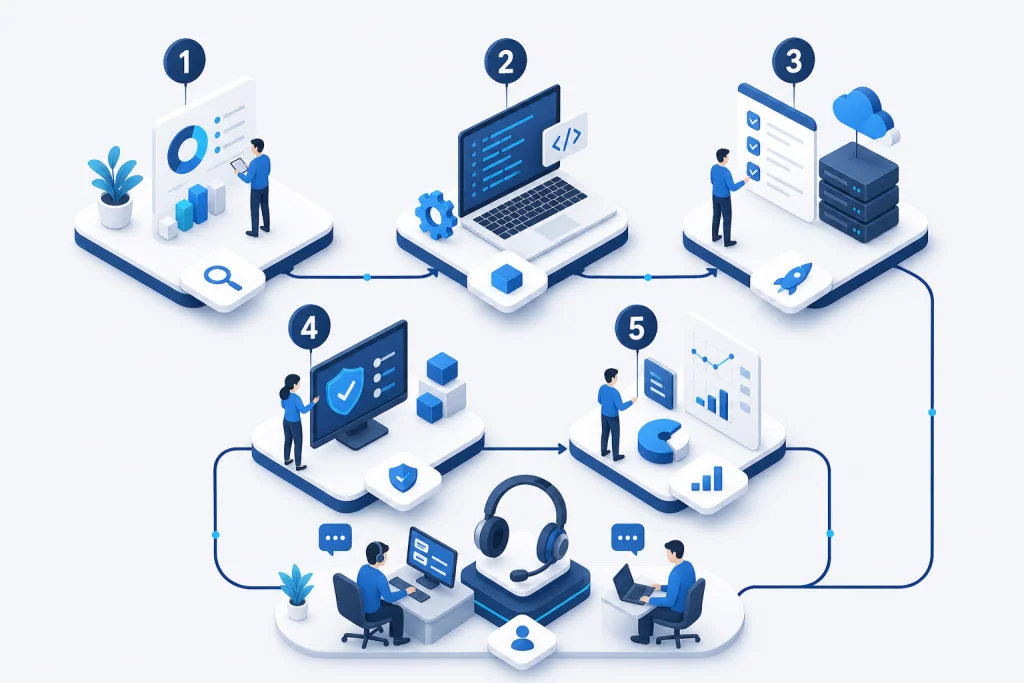
Enterprise implementation methodology

Standard flow for infrastructure, security, and backup projects — scoped per contract.

  1. Discovery & assessment

    Duration: 1–2 weeks

    Deliverables Requirements & risk report

  2. Architecture & BoQ

    Duration: 1–2 weeks

    Deliverables HLD, BoQ, rollout plan

  3. Procurement & staging

    Duration: 2–4 weeks

    Deliverables Asset register

  4. Implementation & UAT

    Duration: 2–6 weeks

    Deliverables As-built, UAT sign-off

  5. Handover & operations

    Duration: Ongoing

    Deliverables SOPs, training, SLA if contracted

Support & SLA (per project contract)

Service levels are defined in agreement — example framework below.

Standard maintenance

Response
Next business day (remote)
Coverage
Firmware advisory, tickets, RMA
Notes
Indonesia business hours

Project warranty

Response
Per implementation contract
Coverage
Defects in Intilogy deployment scope
Notes
Not 24/7 unless agreed

Critical incident (optional)

Response
4–8 hours if contracted
Coverage
Production-critical escalation
Notes
Requires separate MSA

Response times are illustrative — binding only when written in contract.

Technical documentation delivered

  • Topology & rack diagrams (as-built)
  • Asset list, serials, warranty status
  • Critical config summary & change log
  • Basic operations runbook & escalation contacts
  • Restore / DR drill reports (if in scope)
  • Tender packs: distributor letters & engineer certs (on request)

Competency & certifications

Engineers train on vendor technologies per project. Individual certs (Fortinet NSE, VMware VCP, Veeam VMCE, etc.) are provided for tenders — not all listed publicly.

  • Engineer certifications — Per project technology — on request
  • Distributor letters — For procurement audit
  • Client references — See Clients page for logos & scope

View certifications & partnerships

Ready to discuss architecture & BoQ?

Our team supports assessment, recommendations, procurement, and documented implementation.

WhatsApp Consult on WhatsApp
Request Consultation WhatsApp