Enterprise IT Solutions

Pengadaan Storage for Enterprise

Enterprise storage procurement (pengadaan storage) in Indonesia is a critical infrastructure decision that directly impacts data availability, performance, and scalability. Modern enterprises require storage solutions that can handle massive data growth, support virtualization, and ensure business continuity. Whether it's SAN, NAS, or hyperconverged infrastructure (HCI), the choice of storage architecture must align with workload requirements such as databases, virtual machines, or file services. Leading vendors like Dell, HP, Lenovo, Synology, and QNAP offer a range of enterprise-grade storage systems. However, procurement is not just about hardware; it involves capacity planning, redundancy (RAID, erasure coding), connectivity (Fibre Channel, iSCSI, NVMe-oF), and data protection features like snapshots and replication. In Indonesia, where latency to cloud regions can be a concern, on-premises storage remains essential for low-latency applications. Additionally, compliance with local data regulations often requires data residency, making on-premises storage a necessity. A well-designed storage procurement strategy should consider future scalability, integration with existing IT infrastructure, and alignment with disaster recovery plans. Intilogy assists enterprises in selecting the right storage platform, whether it's a high-performance all-flash array for mission-critical databases or a cost-effective hybrid array for general workloads. Our approach includes proof-of-concept testing, vendor benchmarking, and total cost of ownership (TCO) analysis to ensure optimal investment. By combining storage with complementary solutions like Backup & Disaster Recovery and HCI, we help Indonesian enterprises build resilient, high-performing data centers.

Pengadaan Storage Architecture

Enterprise storage architecture encompasses multiple layers: storage controllers, disk enclosures, networking fabrics, and management software. The three primary deployment models are Direct-Attached Storage (DAS), Network-Attached Storage (NAS), and Storage Area Network (SAN). For mission-critical workloads, SAN using Fibre Channel or iSCSI provides block-level access with low latency and high throughput. NAS, on the other hand, is ideal for file sharing and unstructured data, often leveraging protocols like NFS and SMB. Hyperconverged Infrastructure (HCI) converges compute and storage into a single appliance, simplifying management and scaling. Vendors like Dell PowerStore, HP Nimble, and Lenovo ThinkSystem offer all-flash and hybrid arrays. For smaller deployments, Synology and QNAP provide cost-effective NAS solutions with advanced features like SSD caching and snapshot replication. The architecture must also consider data protection: RAID levels, erasure coding, and replication to a secondary site. In Indonesia, where network reliability can vary, asynchronous replication over WAN is common. Additionally, NVMe over Fabrics (NVMe-oF) is emerging for ultra-low latency. Proper architecture design ensures high availability through redundant controllers, power supplies, and paths. Intilogy's architecture team evaluates workload characteristics, growth projections, and budget to design a storage solution that balances performance, capacity, and cost.

Storage tiering is another critical architectural element. By using a mix of high-performance SSDs and high-capacity HDDs, enterprises can optimize cost without compromising performance. Automated tiering moves frequently accessed data to faster tiers. Software-defined storage (SDS) solutions like VMware vSAN or Microsoft Storage Spaces Direct offer flexibility and hardware independence. For backup targets, using dedicated storage with immutable snapshots enhances ransomware protection. The architecture must also integrate with existing backup software such as Veeam or Veritas. In Indonesia, many enterprises adopt a hybrid approach, using on-premises storage for primary workloads and cloud for archival or DR. However, careful planning is needed to avoid egress costs and latency. Intilogy recommends conducting a storage assessment to identify performance bottlenecks and capacity gaps before procurement.

Industry Use Cases for Pengadaan Storage

Enterprise storage serves diverse industries in Indonesia. In banking and finance, high-performance SAN storage is critical for transactional databases, core banking systems, and real-time fraud detection. These environments require sub-millisecond latency and 99.999% availability. All-flash arrays from Dell or HP are common. For healthcare, storage must handle large medical imaging files (PACS) while ensuring compliance with data residency laws. NAS solutions with high capacity and fast access are preferred, often from Synology or QNAP. In manufacturing and logistics, storage supports ERP systems, IoT data ingestion, and video surveillance. Here, hybrid storage with good sequential performance is sufficient. The retail sector uses storage for e-commerce platforms, CRM, and inventory management, requiring both block and file storage. Media and entertainment companies need high-throughput storage for video editing and rendering, often using parallel file systems or object storage. In Indonesia, the government and education sectors also deploy storage for e-learning platforms and citizen services. Each use case demands specific features: snapshots for quick recovery, replication for DR, and integration with virtualization platforms like VMware. Intilogy has implemented storage for clients in these verticals, ensuring compliance with local regulations and performance SLAs.

Another emerging use case is edge storage for remote offices or retail branches. Lightweight NAS devices from QNAP or Synology with local caching and sync capabilities to the central data center are popular. For big data analytics, object storage like Dell EMC ECS or MinIO provides scalability and S3 compatibility. In Indonesia, where cloud adoption is growing but not ubiquitous, on-premises storage remains the backbone for latency-sensitive applications. Intilogy helps clients map their workload requirements to the appropriate storage class, whether it's all-flash, hybrid, or archive. We also consider future needs like AI/ML workloads that require high IOPS and low latency. By understanding the specific use case, we ensure the storage procurement delivers maximum business value.

Pengadaan Storage vs Traditional Alternatives

Traditional storage procurement often involved buying separate servers with internal disks (DAS) or using legacy SAN arrays with limited scalability. Modern enterprise storage, however, offers significant advantages. Compared to DAS, shared storage (SAN/NAS) provides better utilization, centralized management, and high availability through clustering. Traditional SANs with spinning disks are being replaced by all-flash or hybrid arrays that deliver 10x better performance. Hyperconverged infrastructure (HCI) eliminates the need for separate SAN switches and storage arrays, simplifying deployment and scaling. For example, HCI solutions from VMware or Nutanix combine compute and storage in a single appliance, reducing hardware footprint and operational complexity. Another alternative is cloud storage, but in Indonesia, latency to hyperscaler regions can be 10-30ms, making it unsuitable for latency-sensitive workloads. On-premises storage also avoids egress costs and ensures data sovereignty. Software-defined storage (SDS) offers flexibility to use commodity hardware, but requires careful tuning. Compared to traditional monolithic arrays, modern storage systems support non-disruptive upgrades, inline deduplication, and compression, reducing TCO. For backup, traditional tape libraries are now replaced by disk-based backup appliances with deduplication, such as those from Veeam. In summary, modern storage procurement provides better performance, scalability, and data protection than traditional alternatives, with lower total cost of ownership over time.

Another key difference is management simplicity. Traditional storage often required dedicated administrators for zoning, LUN masking, and performance tuning. Modern storage systems offer intuitive web interfaces, automation APIs, and AI-driven analytics. For example, Dell PowerStore with CloudIQ provides proactive health monitoring. This reduces administrative overhead and speeds up troubleshooting. Additionally, modern storage supports multi-protocol access (FC, iSCSI, NFS, SMB) in a single array, simplifying consolidation. In contrast, traditional storage often had separate silos for block and file. When comparing costs, all-flash arrays have higher upfront cost but lower operational cost due to power savings and reduced footprint. Hybrid arrays offer a balance. Intilogy helps clients evaluate these trade-offs through TCO analysis, considering factors like power, cooling, floor space, and administrative effort. We also consider the total cost of data protection, including backup storage and replication bandwidth. By moving to modern storage, Indonesian enterprises can achieve better agility and resilience.

Case Study & Implementation Methodology

Client: Financial Services (Banking), Indonesia. Location: Jakarta. Challenge: The client's existing SAN (HP 3PAR) was nearing end-of-life, with 60% capacity utilization and average latency of 5ms for their core banking database. They needed a solution that could handle 50% data growth over 3 years, support 10,000 IOPS with sub-millisecond latency, and integrate with their VMware environment and backup solution (Veeam). Solution: Intilogy proposed and implemented a Dell PowerStore 5000T all-flash array with 20TB usable capacity, configured with synchronous replication to a secondary site for disaster recovery. The implementation included Fibre Channel connectivity (16Gbps) and integration with VMware vSphere using VAAI for offloading. Result: Latency reduced to 0.5ms (10x improvement), IOPS increased to 50,000, and backup windows shortened by 70% due to integrated snapshots. The client achieved a 3-year TCO reduction of 25% compared to extending the old array. The project was completed in 4 weeks, including data migration using Dell's native tools.

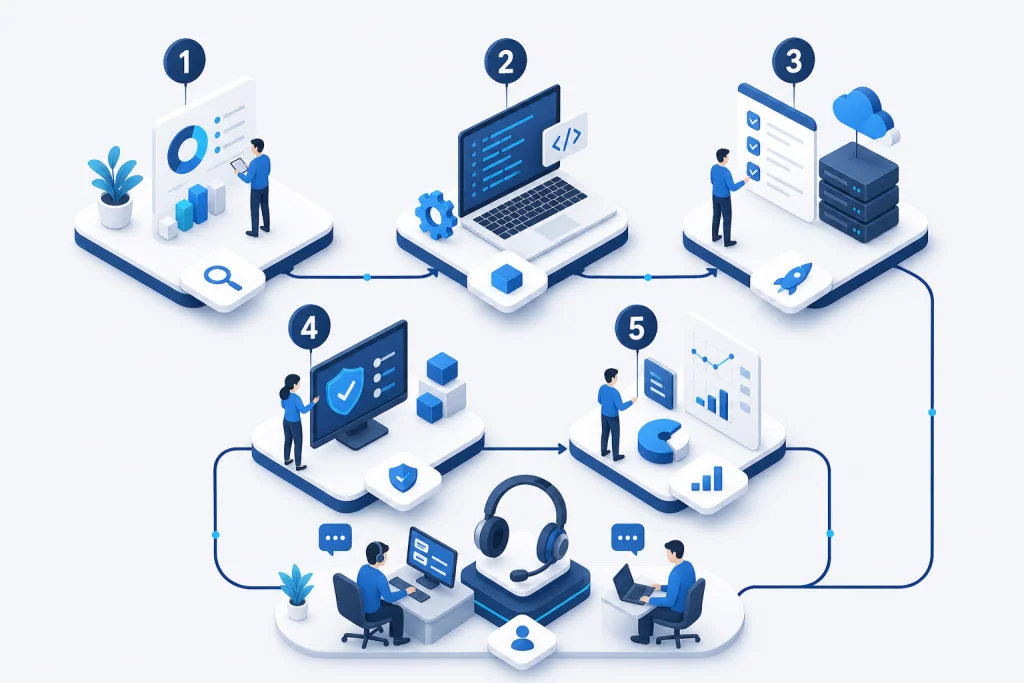
Implementation Methodology: Intilogy follows a structured approach for storage procurement and deployment: 1) Assessment: Analyze current storage environment, performance metrics, capacity trends, and workload requirements. 2) Design: Create a detailed architecture including hardware selection, network topology, data protection strategy, and integration points. 3) Procurement: Manage vendor negotiations, warranty, and delivery logistics. 4) Deployment: Rack and stack, cabling, initial configuration, and storage provisioning. 5) Migration: Use tools like Dell PowerPath or host-based migration to minimize downtime. 6) Testing: Validate performance, failover, and backup restore procedures. 7) Handover: Provide documentation and training to IT staff. We also offer ongoing managed services for monitoring and support. For this banking client, we used a phased migration to avoid business disruption. The methodology ensures that storage procurement delivers measurable business outcomes, such as improved application performance and reduced risk of data loss. Intilogy's team holds certifications from Dell, HP, Lenovo, and VMware, ensuring best practices are followed.

Pengadaan Storage Architecture

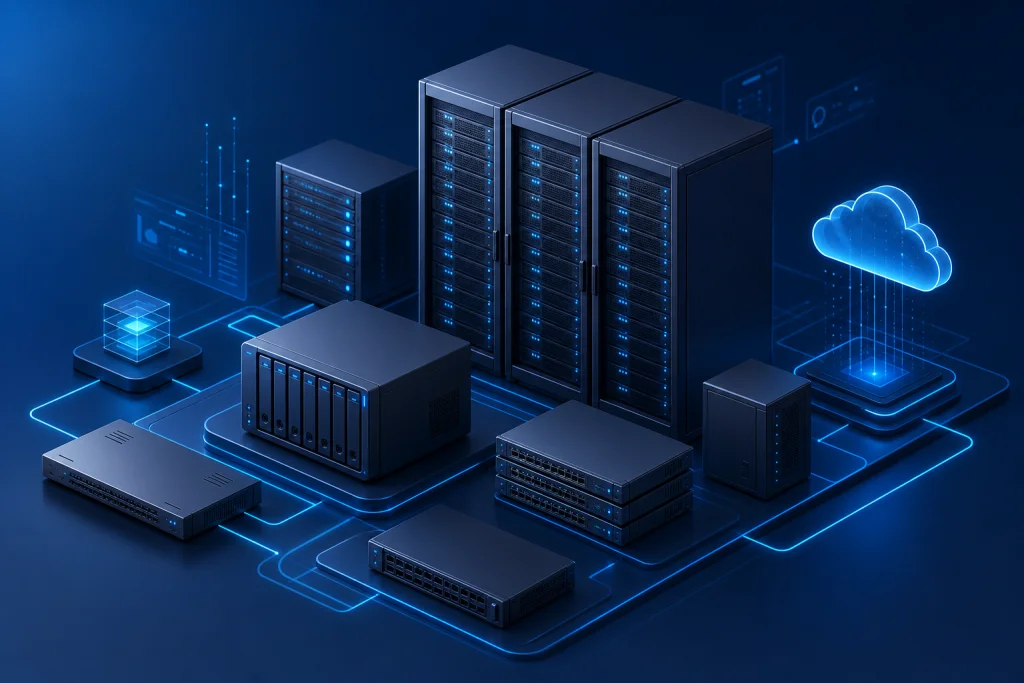
Enterprise storage architecture encompasses multiple layers: storage controllers, disk enclosures, networking fabrics, and management software. The three primary deployment models are Direct-Attached Storage (DAS), Network-Attached Storage (NAS), and Storage Area Network (SAN). For mission-critical workloads, SAN using Fibre Channel or iSCSI provides block-level access with low latency and high throughput. NAS, on the other hand, is ideal for file sharing and unstructured data, often leveraging protocols like NFS and SMB. Hyperconverged Infrastructure (HCI) converges compute and storage into a single appliance, simplifying management and scaling. Vendors like Dell PowerStore, HP Nimble, and Lenovo ThinkSystem offer all-flash and hybrid arrays. For smaller deployments, Synology and QNAP provide cost-effective NAS solutions with advanced features like SSD caching and snapshot replication. The architecture must also consider data protection: RAID levels, erasure coding, and replication to a secondary site. In Indonesia, where network reliability can vary, asynchronous replication over WAN is common. Additionally, NVMe over Fabrics (NVMe-oF) is emerging for ultra-low latency. Proper architecture design ensures high availability through redundant controllers, power supplies, and paths. Intilogy's architecture team evaluates workload characteristics, growth projections, and budget to design a storage solution that balances performance, capacity, and cost.

Industry Use Cases for Pengadaan Storage

Enterprise storage serves diverse industries in Indonesia. In banking and finance, high-performance SAN storage is critical for transactional databases, core banking systems, and real-time fraud detection. These environments require sub-millisecond latency and 99.999% availability. All-flash arrays from Dell or HP are common. For healthcare, storage must handle large medical imaging files (PACS) while ensuring compliance with data residency laws. NAS solutions with high capacity and fast access are preferred, often from Synology or QNAP. In manufacturing and logistics, storage supports ERP systems, IoT data ingestion, and video surveillance. Here, hybrid storage with good sequential performance is sufficient. The retail sector uses storage for e-commerce platforms, CRM, and inventory management, requiring both block and file storage. Media and entertainment companies need high-throughput storage for video editing and rendering, often using parallel file systems or object storage. In Indonesia, the government and education sectors also deploy storage for e-learning platforms and citizen services. Each use case demands specific features: snapshots for quick recovery, replication for DR, and integration with virtualization platforms like VMware. Intilogy has implemented storage for clients in these verticals, ensuring compliance with local regulations and performance SLAs.

How we work

Structured delivery from assessment to handover

Each phase has clear deliverables, owners, and acceptance criteria aligned to enterprise IT practice.

Approach

Pengadaan Storage vs Traditional Alternatives

Traditional storage procurement often involved buying separate servers with internal disks (DAS) or using legacy SAN arrays with limited scalability. Modern enterprise storage, however, offers significant advantages. Compared to DAS, shared storage (SAN/NAS) provides better utilization, centralized management, and high availability through clustering. Traditional SANs with spinning disks are being replaced by all-flash or hybrid arrays that deliver 10x better performance. Hyperconverged infrastructure (HCI) eliminates the need for separate SAN switches and storage arrays, simplifying deployment and scaling. For example, HCI solutions from VMware or Nutanix combine compute and storage in a single appliance, reducing hardware footprint and operational complexity. Another alternative is cloud storage, but in Indonesia, latency to hyperscaler regions can be 10-30ms, making it unsuitable for latency-sensitive workloads. On-premises storage also avoids egress costs and ensures data sovereignty. Software-defined storage (SDS) offers flexibility to use commodity hardware, but requires careful tuning. Compared to traditional monolithic arrays, modern storage systems support non-disruptive upgrades, inline deduplication, and compression, reducing TCO. For backup, traditional tape libraries are now replaced by disk-based backup appliances with deduplication, such as those from Veeam. In summary, modern storage procurement provides better performance, scalability, and data protection than traditional alternatives, with lower total cost of ownership over time.

  • Another key difference is management simplicity. Traditional storage often required dedicated administrators for zoning, LUN masking, and performance tuning. Modern storage systems offer intuitive web interfaces, automation APIs, and AI-driven analytics. For example, Dell PowerStore with CloudIQ provides proactive health monitoring. This reduces administrative overhead and speeds up troubleshooting. Additionally, modern storage supports multi-protocol access (FC, iSCSI, NFS, SMB) in a single array, simplifying consolidation. In contrast, traditional storage often had separate silos for block and file. When comparing costs, all-flash arrays have higher upfront cost but lower operational cost due to power savings and reduced footprint. Hybrid arrays offer a balance. Intilogy helps clients evaluate these trade-offs through TCO analysis, considering factors like power, cooling, floor space, and administrative effort. We also consider the total cost of data protection, including backup storage and replication bandwidth. By moving to modern storage, Indonesian enterprises can achieve better agility and resilience.

Capabilities

Case Study & Implementation Methodology

Client: Financial Services (Banking), Indonesia. Location: Jakarta. Challenge: The client's existing SAN (HP 3PAR) was nearing end-of-life, with 60% capacity utilization and average latency of 5ms for their core banking database. They needed a solution that could handle 50% data growth over 3 years, support 10,000 IOPS with sub-millisecond latency, and integrate with their VMware environment and backup solution (Veeam). Solution: Intilogy proposed and implemented a Dell PowerStore 5000T all-flash array with 20TB usable capacity, configured with synchronous replication to a secondary site for disaster recovery. The implementation included Fibre Channel connectivity (16Gbps) and integration with VMware vSphere using VAAI for offloading. Result: Latency reduced to 0.5ms (10x improvement), IOPS increased to 50,000, and backup windows shortened by 70% due to integrated snapshots. The client achieved a 3-year TCO reduction of 25% compared to extending the old array. The project was completed in 4 weeks, including data migration using Dell's native tools.

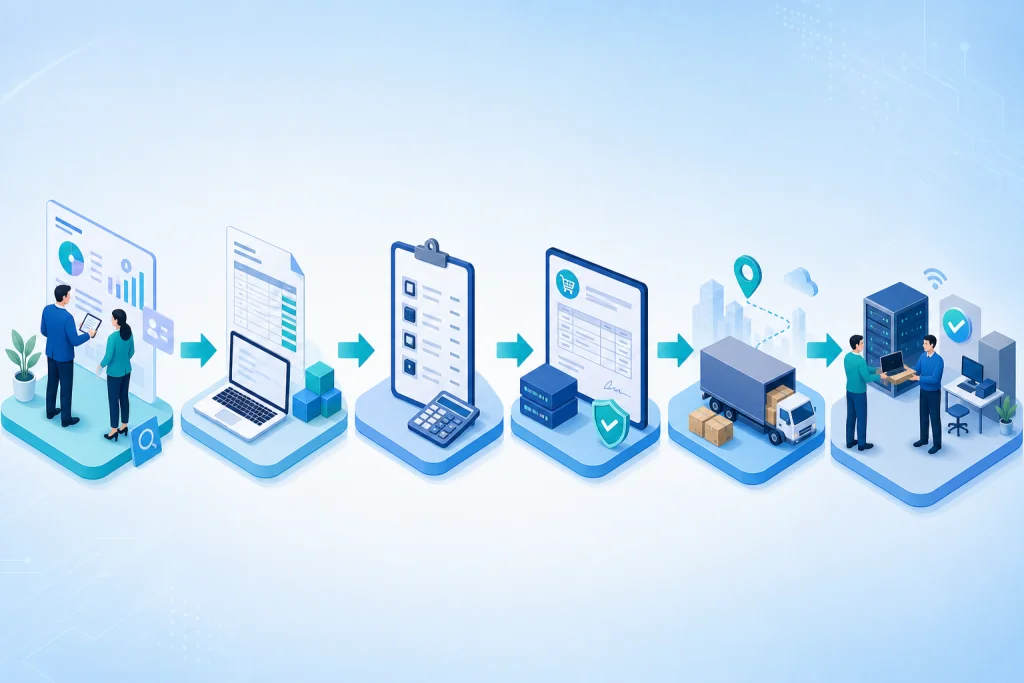
  • Implementation Methodology: Intilogy follows a structured approach for storage procurement and deployment: 1) Assessment: Analyze current storage environment, performance metrics, capacity trends, and workload requirements. 2) Design: Create a detailed architecture including hardware selection, network topology, data protection strategy, and integration points. 3) Procurement: Manage vendor negotiations, warranty, and delivery logistics. 4) Deployment: Rack and stack, cabling, initial configuration, and storage provisioning. 5) Migration: Use tools like Dell PowerPath or host-based migration to minimize downtime. 6) Testing: Validate performance, failover, and backup restore procedures. 7) Handover: Provide documentation and training to IT staff. We also offer ongoing managed services for monitoring and support. For this banking client, we used a phased migration to avoid business disruption. The methodology ensures that storage procurement delivers measurable business outcomes, such as improved application performance and reduced risk of data loss. Intilogy's team holds certifications from Dell, HP, Lenovo, and VMware, ensuring best practices are followed.
Pengadaan Storage for Enterprise

Our engineers help design, deploy, and support enterprise IT solutions across Indonesia.

Request a quote Contact our team

Related pages

Ready to discuss architecture & BoQ?

Our team supports assessment, recommendations, procurement, and documented implementation.

WhatsApp Consult on WhatsApp
Request Consultation WhatsApp