Enterprise IT Solutions

Wireless Network for Enterprise

A modern enterprise wireless network is no longer a convenience but a critical backbone for digital operations, especially in Indonesia's rapidly growing business landscape. For B2B enterprises, the shift from basic connectivity to high-performance, secure, and scalable WiFi infrastructure is essential to support IoT devices, real-time analytics, and unified communications. Deploying a robust wireless network involves selecting the right architecture—such as controller-based or cloud-managed—and leveraging technologies like WiFi 6 (802.11ax) and WiFi 6E to deliver low latency, high throughput, and efficient spectrum utilization in dense environments. Key considerations include seamless roaming for mobile workers, Quality of Service (QoS) for voice and video, and advanced security protocols like WPA3-Enterprise and 802.1X authentication. In Indonesia, enterprises across manufacturing, logistics, education, and healthcare require tailored solutions that address local challenges like interference in unlicensed bands, multi-story building coverage, and integration with existing wired networking infrastructure. A comprehensive wireless network strategy also encompasses site surveys, RF planning, and ongoing optimization using tools like Ekahau or AirMagnet. By partnering with vendors such as Cisco, Ruijie, and Aruba, enterprises can achieve reliable connectivity that supports mission-critical applications. Additionally, integrating wireless with cybersecurity frameworks ensures data protection and compliance with regulations. This content explores the architecture, use cases, comparative advantages, and implementation methodology for enterprise wireless networks in Indonesia.

Wireless Network Architecture

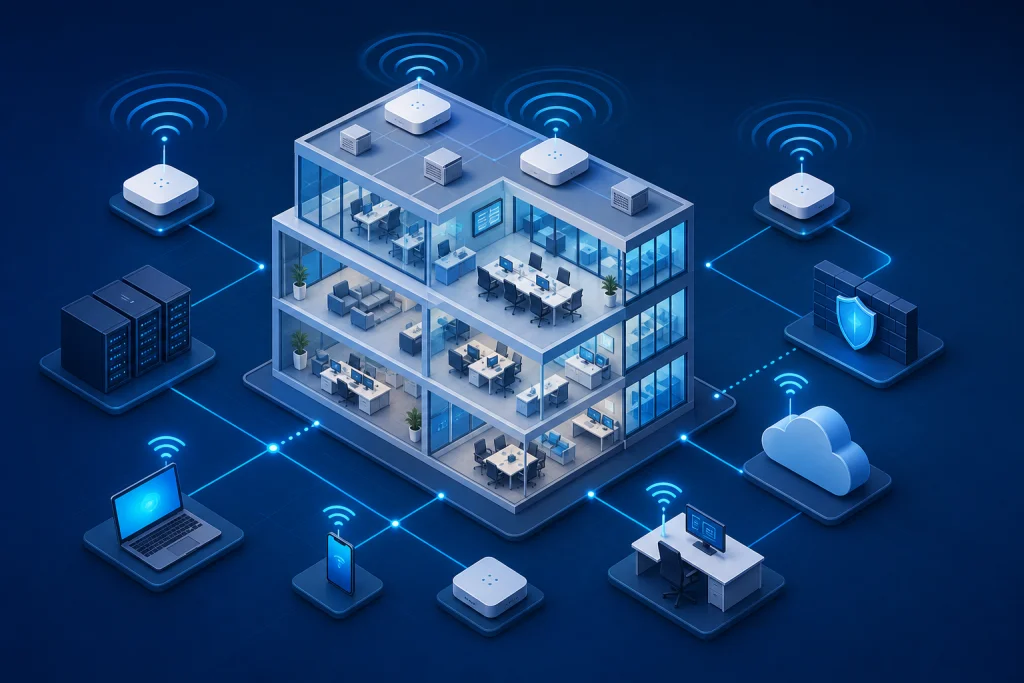
Enterprise wireless architecture typically follows a three-tier model: access points (APs), wireless LAN controllers (WLCs), and network management platforms. In high-density environments such as convention centers or warehouses, a centralized architecture with thin APs and a controller is preferred for centralized policy enforcement and seamless roaming. Alternatively, cloud-managed architectures (e.g., Cisco Meraki, Ruijie Cloud) offer simplified management and scalability for multi-site deployments. Key components include APs supporting OFDMA and MU-MIMO for efficient channel utilization, and controllers that handle client load balancing and band steering. For large-scale Indonesian enterprises, a hierarchical design with distribution and core switches is recommended to segment traffic and ensure low latency. Integration with hyperconverged infrastructure can further streamline operations by converging compute and networking resources.

Advanced features like 802.1X authentication with RADIUS servers, dynamic VLAN assignment, and application-aware QoS are critical for securing and prioritizing traffic. In campus environments, mesh networking can extend coverage without cabling, but careful planning is required to avoid backhaul bottlenecks. The architecture must also support future upgrades to WiFi 7 (802.11be) and incorporate AI-driven analytics for proactive troubleshooting. For example, Cisco DNA Center provides intent-based networking, while Ruijie's RG-AP series offers high-density performance. A well-designed architecture reduces total cost of ownership by minimizing downtime and optimizing spectrum usage.

Industry Use Cases for Wireless Network

In Indonesian manufacturing, wireless networks enable real-time tracking of assets and inventory using RFID and IoT sensors. For instance, a automotive parts factory in Bekasi deployed WiFi 6 APs to support automated guided vehicles (AGVs) and handheld scanners, achieving 99.9% uptime and reducing material handling errors by 30%. In logistics, warehouse operators in Surabaya use wireless networks for barcode scanning and voice-picking systems, with seamless roaming across 50,000 sqm facilities. The enterprise WiFi solution ensures low latency for voice commands and high throughput for video surveillance.

Healthcare institutions like hospitals in Jakarta rely on wireless for electronic medical records (EMR) access, telemedicine, and real-time location services (RTLS) for equipment tracking. A hospital with 500+ beds deployed Aruba APs with WPA3-Enterprise to secure patient data while supporting 2,000 concurrent devices. In education, universities in Bandung use wireless for online learning platforms and campus-wide IoT, with capacity for 10,000+ students. The network integrates with hybrid cloud services for scalable storage and analytics. Retail chains in shopping malls deploy wireless for POS systems, digital signage, and customer analytics, requiring high-density coverage and guest access with captive portals.

Wireless Network vs Traditional Alternatives

Traditional wired networks offer deterministic performance and security but lack mobility and scalability for modern enterprise needs. Wireless networks, especially with WiFi 6/6E, now rival wired speeds while providing flexibility for IoT and mobile workforce. In terms of cost, wired cabling in large facilities like factories can be prohibitive, whereas wireless reduces installation time and material costs by up to 40%. However, wireless must address interference and security challenges. For example, legacy WPA2 is vulnerable to KRACK attacks, while WPA3-Enterprise with 192-bit encryption is now standard. Compared to cellular alternatives like 5G private networks, WiFi offers lower latency (sub-10ms) and higher throughput for indoor use, but 5G provides better wide-area coverage. For Indonesian enterprises, a hybrid approach often works best: wireless LAN for indoor and campus, and cellular for outdoor or remote sites.

Another alternative is Li-Fi, which uses light for data transmission but is limited by line-of-sight and range. Wireless networks also integrate with backup and disaster recovery solutions to ensure continuity. For instance, a manufacturing plant in Batam replaced 80% of wired connections with WiFi 6, achieving 1.2 Gbps per AP and reducing maintenance costs. The key trade-off is that wireless requires careful RF planning and ongoing optimization, whereas wired is 'set and forget.' However, with AI-driven management tools, wireless can now self-heal and adapt to changing conditions, making it a superior choice for agile enterprises.

Case Study & Implementation Methodology

Implementation methodology begins with a site survey and RF planning using tools like Ekahau to identify coverage gaps and interference. For a logistics warehouse in Tangerang (50,000 sqm), the challenge was supporting 500+ handheld scanners and 200 AGVs with zero packet loss during handoffs. The solution deployed 120 Ruijie RG-AP880-I access points with dual 5 GHz radios and a cloud controller. Result: 40% improvement in inventory accuracy, 25% reduction in picking time, and 99.95% uptime over 12 months. The network also integrated with existing server and storage infrastructure for real-time data logging.

Another case: a university in Yogyakarta with 10,000 students needed to support online exams and video streaming. Challenge: high-density auditoriums with 500+ concurrent users per AP. Solution: 200 Cisco Catalyst 9130AXI APs with OFDMA and 8x8 MU-MIMO, plus Cisco DNA Center for analytics. Result: 50% reduction in buffering, 30% increase in student satisfaction, and seamless roaming across 20 buildings. The implementation followed a phased approach: pilot in one faculty, then full rollout with training for IT staff. Post-deployment, continuous monitoring via SNMP and syslog ensures performance. This methodology aligns with ITIL best practices and can be replicated for any enterprise in Indonesia.

Wireless Network Architecture

Enterprise wireless architecture typically follows a three-tier model: access points (APs), wireless LAN controllers (WLCs), and network management platforms. In high-density environments such as convention centers or warehouses, a centralized architecture with thin APs and a controller is preferred for centralized policy enforcement and seamless roaming. Alternatively, cloud-managed architectures (e.g., Cisco Meraki, Ruijie Cloud) offer simplified management and scalability for multi-site deployments. Key components include APs supporting OFDMA and MU-MIMO for efficient channel utilization, and controllers that handle client load balancing and band steering. For large-scale Indonesian enterprises, a hierarchical design with distribution and core switches is recommended to segment traffic and ensure low latency. Integration with hyperconverged infrastructure can further streamline operations by converging compute and networking resources.

Industry Use Cases for Wireless Network

In Indonesian manufacturing, wireless networks enable real-time tracking of assets and inventory using RFID and IoT sensors. For instance, a automotive parts factory in Bekasi deployed WiFi 6 APs to support automated guided vehicles (AGVs) and handheld scanners, achieving 99.9% uptime and reducing material handling errors by 30%. In logistics, warehouse operators in Surabaya use wireless networks for barcode scanning and voice-picking systems, with seamless roaming across 50,000 sqm facilities. The enterprise WiFi solution ensures low latency for voice commands and high throughput for video surveillance.

How we work

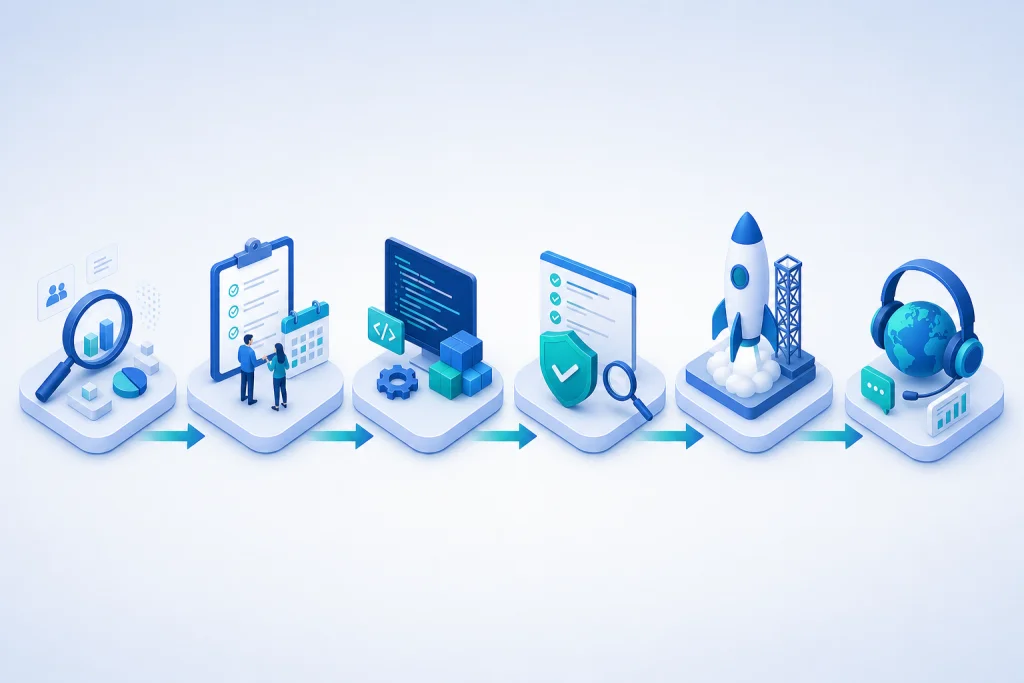
Structured delivery from assessment to handover

Each phase has clear deliverables, owners, and acceptance criteria aligned to enterprise IT practice.

Approach

Wireless Network vs Traditional Alternatives

Traditional wired networks offer deterministic performance and security but lack mobility and scalability for modern enterprise needs. Wireless networks, especially with WiFi 6/6E, now rival wired speeds while providing flexibility for IoT and mobile workforce. In terms of cost, wired cabling in large facilities like factories can be prohibitive, whereas wireless reduces installation time and material costs by up to 40%. However, wireless must address interference and security challenges. For example, legacy WPA2 is vulnerable to KRACK attacks, while WPA3-Enterprise with 192-bit encryption is now standard. Compared to cellular alternatives like 5G private networks, WiFi offers lower latency (sub-10ms) and higher throughput for indoor use, but 5G provides better wide-area coverage. For Indonesian enterprises, a hybrid approach often works best: wireless LAN for indoor and campus, and cellular for outdoor or remote sites.

  • Another alternative is Li-Fi, which uses light for data transmission but is limited by line-of-sight and range. Wireless networks also integrate with backup and disaster recovery solutions to ensure continuity. For instance, a manufacturing plant in Batam replaced 80% of wired connections with WiFi 6, achieving 1.2 Gbps per AP and reducing maintenance costs. The key trade-off is that wireless requires careful RF planning and ongoing optimization, whereas wired is 'set and forget.' However, with AI-driven management tools, wireless can now self-heal and adapt to changing conditions, making it a superior choice for agile enterprises.

Capabilities

Case Study & Implementation Methodology

Implementation methodology begins with a site survey and RF planning using tools like Ekahau to identify coverage gaps and interference. For a logistics warehouse in Tangerang (50,000 sqm), the challenge was supporting 500+ handheld scanners and 200 AGVs with zero packet loss during handoffs. The solution deployed 120 Ruijie RG-AP880-I access points with dual 5 GHz radios and a cloud controller. Result: 40% improvement in inventory accuracy, 25% reduction in picking time, and 99.95% uptime over 12 months. The network also integrated with existing server and storage infrastructure for real-time data logging.

  • Another case: a university in Yogyakarta with 10,000 students needed to support online exams and video streaming. Challenge: high-density auditoriums with 500+ concurrent users per AP. Solution: 200 Cisco Catalyst 9130AXI APs with OFDMA and 8x8 MU-MIMO, plus Cisco DNA Center for analytics. Result: 50% reduction in buffering, 30% increase in student satisfaction, and seamless roaming across 20 buildings. The implementation followed a phased approach: pilot in one faculty, then full rollout with training for IT staff. Post-deployment, continuous monitoring via SNMP and syslog ensures performance. This methodology aligns with ITIL best practices and can be replicated for any enterprise in Indonesia.
Use cases

Perencanaan infrastruktur baru

Refresh & modernisasi

Ekspansi multi-cabang

Compliance & audit IT

Wireless Network for Enterprise

Our engineers help design, deploy, and support enterprise IT solutions across Indonesia.

Request a quote Contact our team

Related pages

E-E-A-T · Expertise & trust

Implementation expertise & enterprise trust

Intilogy (PT. Inti Jaya Teknologi) supports IT and procurement teams across Indonesia — from technical assessment and BoQ through deployment, documentation, and post go-live support.

  • 500+ Infrastructure deployments
  • 24/7 Operational support
  • SLA Enterprise SLA
  • 150+ Clients & institutions

Engineering & delivery expertise

Engineer-led assessment

Requirements workshops, sizing, and architecture — not catalogue selling without context.

Documented deployment

Commissioning checklists, as-built diagrams, IP plans, and escalation runbooks.

Audit-ready procurement

BoQ/BOM, quotations, POs, and handover packs for tenders and IT audits.

Multi-vendor coordination

One project partner for servers, networks, security, backup, and licensing.

Vendor ecosystem & sourcing channels

We source through official distributors/resellers per brand and project. Specific partnership tiers are confirmed per RFP — see our credentials page.

Vendor Status / tier Scope Notes
Dell Technologies Authorized channel PowerEdge, storage BoQ & manufacturer warranty
HPE Authorized channel ProLiant Enterprise servers
Fortinet Implementation partner NGFW, SD-WAN Licensing & deployment
Veeam Implementation partner Backup, replication Immutable design
VMware Implementation partner vSphere Cluster & migration

Tiers vary by SKU/region. Contact sales@intilogy.com for distributor letters or engineer certificates.

Enterprise implementation methodology

Standard flow for infrastructure, security, and backup projects — scoped per contract.

  1. Discovery & assessment

    Duration: 1–2 weeks

    Deliverables Requirements & risk report

  2. Architecture & BoQ

    Duration: 1–2 weeks

    Deliverables HLD, BoQ, rollout plan

  3. Procurement & staging

    Duration: 2–4 weeks

    Deliverables Asset register

  4. Implementation & UAT

    Duration: 2–6 weeks

    Deliverables As-built, UAT sign-off

  5. Handover & operations

    Duration: Ongoing

    Deliverables SOPs, training, SLA if contracted

Support & SLA (per project contract)

Service levels are defined in agreement — example framework below.

Standard maintenance

Response
Next business day (remote)
Coverage
Firmware advisory, tickets, RMA
Notes
Indonesia business hours

Project warranty

Response
Per implementation contract
Coverage
Defects in Intilogy deployment scope
Notes
Not 24/7 unless agreed

Critical incident (optional)

Response
4–8 hours if contracted
Coverage
Production-critical escalation
Notes
Requires separate MSA

Response times are illustrative — binding only when written in contract.

Technical documentation delivered

  • Topology & rack diagrams (as-built)
  • Asset list, serials, warranty status
  • Critical config summary & change log
  • Basic operations runbook & escalation contacts
  • Restore / DR drill reports (if in scope)
  • Tender packs: distributor letters & engineer certs (on request)

Competency & certifications

Engineers train on vendor technologies per project. Individual certs (Fortinet NSE, VMware VCP, Veeam VMCE, etc.) are provided for tenders — not all listed publicly.

  • Engineer certifications — Per project technology — on request
  • Distributor letters — For procurement audit
  • Client references — See Clients page for logos & scope

View certifications & partnerships

Ready to discuss architecture & BoQ?

Our team supports assessment, recommendations, procurement, and documented implementation.

WhatsApp Consult on WhatsApp
Request Consultation WhatsApp