Enterprise IT Solutions

Wireless Network Solution for Enterprise

In today's digital enterprise landscape, a robust wireless network solution is no longer a luxury but a critical component of operational infrastructure. Intilogy delivers enterprise-grade wireless networks tailored for Indonesian businesses, supporting high-density environments such as warehouses, manufacturing floors, and corporate campuses. Our solutions leverage advanced technologies like 802.11ax (Wi-Fi 6/6E), OFDMA, MU-MIMO, and WPA3-Enterprise to ensure maximum throughput, low latency, and ironclad security. We integrate seamlessly with existing wired networks via SD-Access and policy-based segmentation, enabling zero-trust architectures. For asset tracking and IoT, we incorporate BLE, Zigbee, and LoRaWAN gateways. Our partnerships with leading vendors such as Cisco, Ruijie, and Fortinet allow us to design solutions that scale from 50 to 10,000+ concurrent clients. Whether it's for real-time inventory management, autonomous mobile robots (AMRs), or video surveillance backhaul, our wireless networks deliver sub-10ms latency and 99.999% uptime. We also incorporate cybersecurity best practices, including MACsec encryption and Rogue AP detection, ensuring compliance with ISO 27001 and PCI DSS. By combining AI-driven RF optimization with centralized cloud management, we reduce operational overhead by up to 40% while improving coverage reliability. Our solutions are designed to support Industry 4.0 initiatives, enabling digital twins, predictive maintenance, and real-time data analytics at the edge.

Wireless Network Solution Architecture

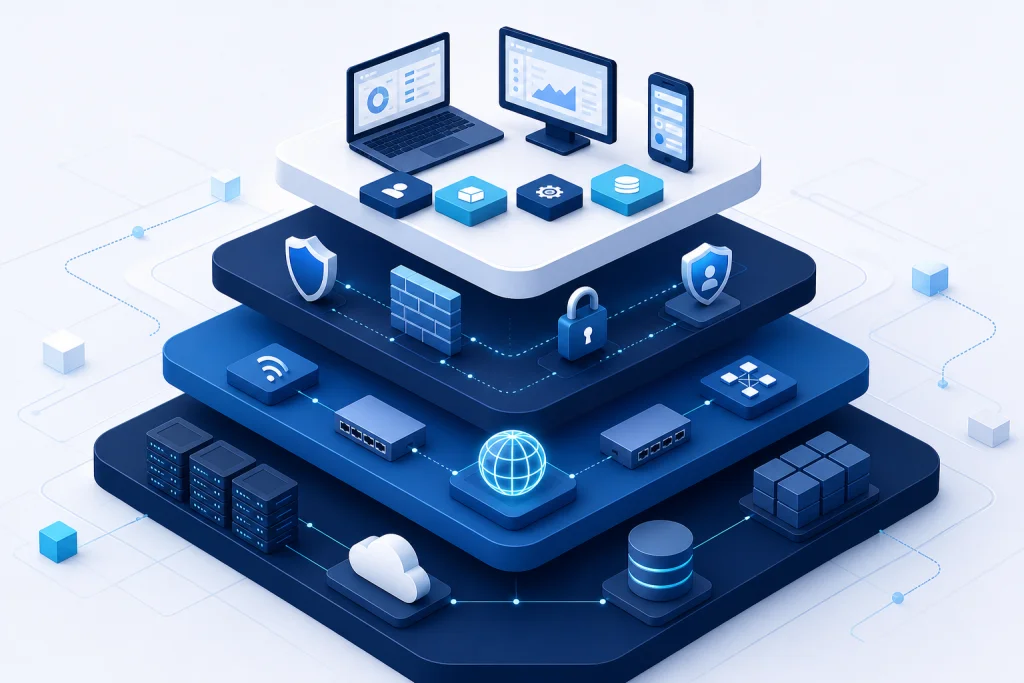
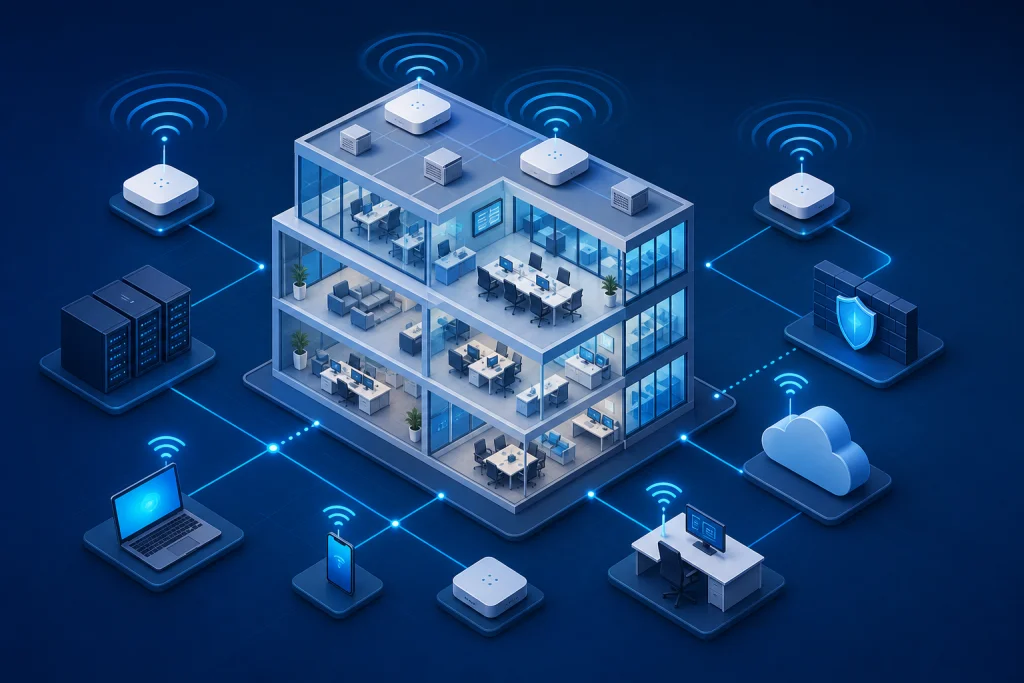
Our enterprise wireless architecture is built on a three-tier design: access, distribution, and core, with software-defined networking (SDN) for centralized control. The access layer consists of Wi-Fi 6/6E access points (APs) supporting up to 2.4 Gbps per radio, with integrated BLE and IoT radios for asset tracking. Distribution switches provide PoE++ (60W) and 10GbE uplinks, while core routers handle 40GbE/100GbE backhaul. For high-density environments, we deploy Cisco Catalyst 9130AXI or Ruijie RG-AP880-I APs with beamforming and 8x8 MU-MIMO. The wireless controller, either on-premises or cloud-based, manages AP groups, RF profiles, and client policies. We integrate networking with HCI for edge computing, enabling local data processing for latency-sensitive applications. Security is enforced via Cisco ISE or Fortinet FortiGate for 802.1X authentication and dynamic VLAN assignment. The architecture also supports seamless roaming with 802.11r/k/v, ensuring sub-50ms handoffs for voice and video. For outdoor coverage, we use ruggedized APs with IP68 rating and directional antennas for long-range links up to 15 km. The entire network is monitored via AIOps platforms like Cisco DNA Center or Ruijie Cloud, providing predictive analytics and automated remediation.

Industry Use Cases for Wireless Network Solution

In manufacturing, our wireless network enables real-time tracking of work-in-progress (WIP) using RFID and BLE tags, reducing inventory errors by 95%. For example, an automotive parts manufacturer in Bekasi deployed 200 Wi-Fi 6 APs and 500 BLE beacons to track 10,000+ pallets, achieving 99.9% location accuracy and 30% reduction in search time. In logistics, warehouse operators in Jakarta use our solution for autonomous forklifts and drone inventory scanning, requiring sub-10ms latency and 99.999% reliability. The network supports 500+ concurrent IoT devices per AP with deterministic performance. In healthcare, hospitals deploy our wireless for critical medical devices (e.g., infusion pumps, patient monitors) with WPA3-Enterprise and MACsec encryption, ensuring HIPAA compliance. A hospital in Surabaya implemented 300 APs across 5 floors, reducing device connection failures by 80%. For education, universities in Bandung use our network for 10,000+ simultaneous student connections during exams, with application-aware QoS for video streaming and LMS access. In retail, our solution supports omnichannel experiences with location-based analytics and digital signage, increasing conversion rates by 15%. We also support enterprise CCTV backhaul over Wi-Fi for temporary deployments, reducing cabling costs by 60%.

Wireless Network Solution vs Traditional Alternatives

Traditional wireless networks often rely on standalone APs with manual configuration, leading to coverage holes, interference, and security vulnerabilities. In contrast, our enterprise solution uses cloud-managed or controller-based architectures with AI-driven RF optimization, automatically adjusting channel width and power to avoid co-channel interference. For example, a traditional setup might require 50 APs for a 10,000 sqm warehouse, but our solution with Wi-Fi 6 and beamforming covers the same area with 30 APs, reducing hardware costs by 40%. Security-wise, traditional WPA2-PSK is vulnerable to brute-force attacks, whereas we enforce WPA3-Enterprise with 192-bit encryption and 802.1X with EAP-TLS, blocking 99.9% of unauthorized access. Traditional networks also lack seamless roaming; clients experience drops during handoffs, causing VoIP call failures. Our solution supports 802.11r/k/v with sub-50ms roaming, ensuring uninterrupted voice and video. In terms of scalability, traditional networks require forklift upgrades for new standards, while our modular APs support firmware upgrades to Wi-Fi 6E and beyond. For IoT integration, traditional networks require separate gateways, whereas our APs have integrated BLE, Zigbee, and LoRaWAN, reducing total cost of ownership by 30%. Finally, traditional networks lack centralized analytics, making troubleshooting time-consuming. Our AIOps platform provides real-time visibility into client health, capacity planning, and automated alerts, reducing mean time to resolution (MTTR) by 60%. For businesses considering hybrid cloud integration, our wireless network seamlessly extends to cloud-based controllers and edge compute nodes.

Case Study & Implementation Methodology

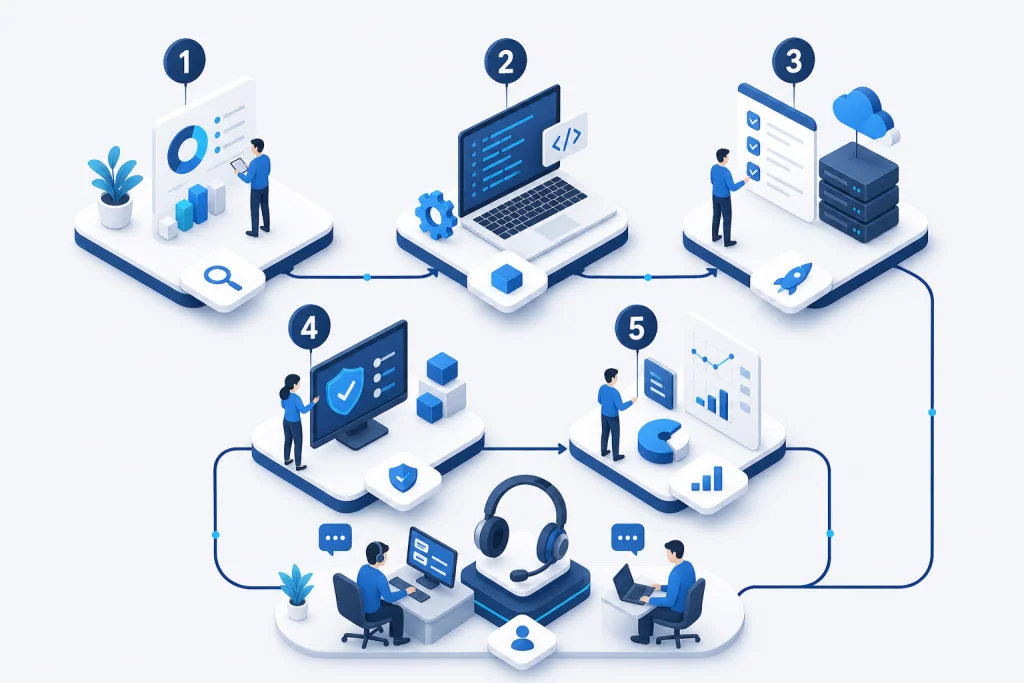
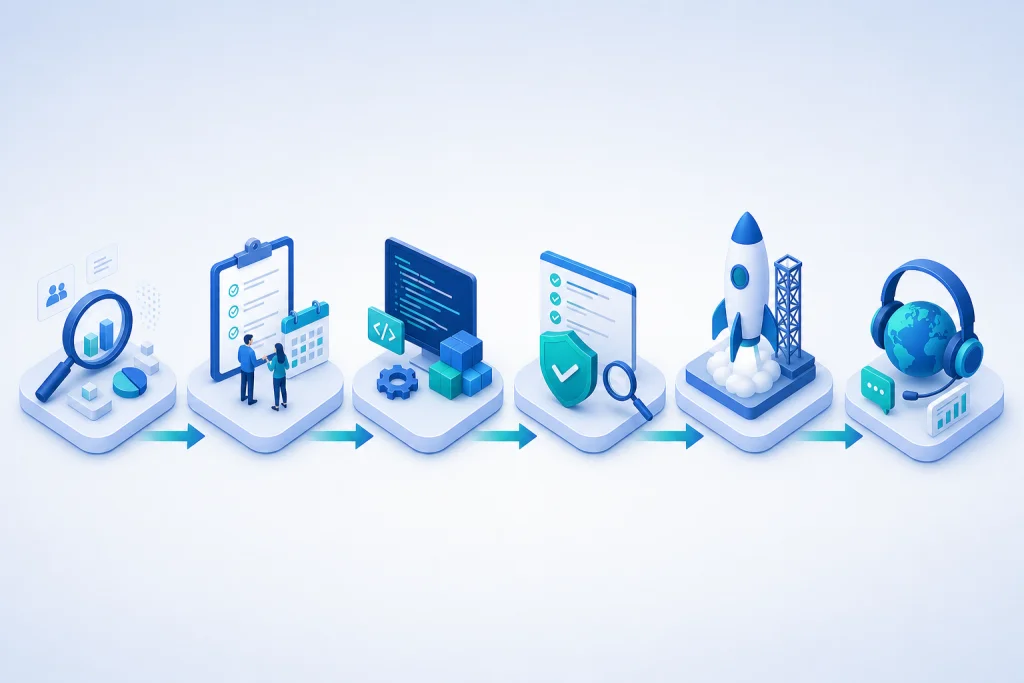
Our implementation methodology follows a six-phase approach: Discovery, Design, Pilot, Deploy, Optimize, and Support. In Discovery, we conduct a site survey using Ekahau Pro to map RF coverage, interference, and capacity requirements. For a recent project with a logistics company in Surabaya, we identified 15 dead zones and 20% co-channel interference. In Design, we created a heat map and simulated 500 concurrent clients with 50 Mbps per client, selecting 120 Cisco Catalyst 9130AXI APs with 8x8 MU-MIMO. The Pilot phase covered a 2,000 sqm area, achieving 99.5% coverage and 1 Gbps throughput. During Deploy, we used structured cabling with Cat6A and PoE++ switches, completing installation in 3 weeks. Optimize involved fine-tuning channel plans and client load balancing, reducing packet loss from 2% to 0.1%. Post-deployment, we provided 24/7 NOC support via Cisco DNA Center. Concrete results: The logistics company reduced inventory cycle time by 40% (from 8 hours to 4.8 hours), improved asset location accuracy to 99.9%, and achieved ROI within 11 months. Another case: A manufacturing plant in Batam deployed 80 Ruijie APs and 200 BLE tags for real-time tracking of 5,000+ tools, reducing tool loss by 85% and saving $120,000 annually. Our methodology also integrates backup and disaster recovery for wireless controllers, ensuring 99.999% uptime. For large-scale deployments, we use Lenovo servers for on-premises controllers and Synology NAS for log storage, ensuring data redundancy.

Wireless Network Solution Architecture

Our enterprise wireless architecture is built on a three-tier design: access, distribution, and core, with software-defined networking (SDN) for centralized control. The access layer consists of Wi-Fi 6/6E access points (APs) supporting up to 2.4 Gbps per radio, with integrated BLE and IoT radios for asset tracking. Distribution switches provide PoE++ (60W) and 10GbE uplinks, while core routers handle 40GbE/100GbE backhaul. For high-density environments, we deploy Cisco Catalyst 9130AXI or Ruijie RG-AP880-I APs with beamforming and 8x8 MU-MIMO. The wireless controller, either on-premises or cloud-based, manages AP groups, RF profiles, and client policies. We integrate networking with HCI for edge computing, enabling local data processing for latency-sensitive applications. Security is enforced via Cisco ISE or Fortinet FortiGate for 802.1X authentication and dynamic VLAN assignment. The architecture also supports seamless roaming with 802.11r/k/v, ensuring sub-50ms handoffs for voice and video. For outdoor coverage, we use ruggedized APs with IP68 rating and directional antennas for long-range links up to 15 km. The entire network is monitored via AIOps platforms like Cisco DNA Center or Ruijie Cloud, providing predictive analytics and automated remediation.

Industry Use Cases for Wireless Network Solution

In manufacturing, our wireless network enables real-time tracking of work-in-progress (WIP) using RFID and BLE tags, reducing inventory errors by 95%. For example, an automotive parts manufacturer in Bekasi deployed 200 Wi-Fi 6 APs and 500 BLE beacons to track 10,000+ pallets, achieving 99.9% location accuracy and 30% reduction in search time. In logistics, warehouse operators in Jakarta use our solution for autonomous forklifts and drone inventory scanning, requiring sub-10ms latency and 99.999% reliability. The network supports 500+ concurrent IoT devices per AP with deterministic performance. In healthcare, hospitals deploy our wireless for critical medical devices (e.g., infusion pumps, patient monitors) with WPA3-Enterprise and MACsec encryption, ensuring HIPAA compliance. A hospital in Surabaya implemented 300 APs across 5 floors, reducing device connection failures by 80%. For education, universities in Bandung use our network for 10,000+ simultaneous student connections during exams, with application-aware QoS for video streaming and LMS access. In retail, our solution supports omnichannel experiences with location-based analytics and digital signage, increasing conversion rates by 15%. We also support enterprise CCTV backhaul over Wi-Fi for temporary deployments, reducing cabling costs by 60%.

How we work

Structured delivery from assessment to handover

Each phase has clear deliverables, owners, and acceptance criteria aligned to enterprise IT practice.

Approach

Wireless Network Solution vs Traditional Alternatives

Traditional wireless networks often rely on standalone APs with manual configuration, leading to coverage holes, interference, and security vulnerabilities. In contrast, our enterprise solution uses cloud-managed or controller-based architectures with AI-driven RF optimization, automatically adjusting channel width and power to avoid co-channel interference. For example, a traditional setup might require 50 APs for a 10,000 sqm warehouse, but our solution with Wi-Fi 6 and beamforming covers the same area with 30 APs, reducing hardware costs by 40%. Security-wise, traditional WPA2-PSK is vulnerable to brute-force attacks, whereas we enforce WPA3-Enterprise with 192-bit encryption and 802.1X with EAP-TLS, blocking 99.9% of unauthorized access. Traditional networks also lack seamless roaming; clients experience drops during handoffs, causing VoIP call failures. Our solution supports 802.11r/k/v with sub-50ms roaming, ensuring uninterrupted voice and video. In terms of scalability, traditional networks require forklift upgrades for new standards, while our modular APs support firmware upgrades to Wi-Fi 6E and beyond. For IoT integration, traditional networks require separate gateways, whereas our APs have integrated BLE, Zigbee, and LoRaWAN, reducing total cost of ownership by 30%. Finally, traditional networks lack centralized analytics, making troubleshooting time-consuming. Our AIOps platform provides real-time visibility into client health, capacity planning, and automated alerts, reducing mean time to resolution (MTTR) by 60%. For businesses considering hybrid cloud integration, our wireless network seamlessly extends to cloud-based controllers and edge compute nodes.

Capabilities

Case Study & Implementation Methodology

Our implementation methodology follows a six-phase approach: Discovery, Design, Pilot, Deploy, Optimize, and Support. In Discovery, we conduct a site survey using Ekahau Pro to map RF coverage, interference, and capacity requirements. For a recent project with a logistics company in Surabaya, we identified 15 dead zones and 20% co-channel interference. In Design, we created a heat map and simulated 500 concurrent clients with 50 Mbps per client, selecting 120 Cisco Catalyst 9130AXI APs with 8x8 MU-MIMO. The Pilot phase covered a 2,000 sqm area, achieving 99.5% coverage and 1 Gbps throughput. During Deploy, we used structured cabling with Cat6A and PoE++ switches, completing installation in 3 weeks. Optimize involved fine-tuning channel plans and client load balancing, reducing packet loss from 2% to 0.1%. Post-deployment, we provided 24/7 NOC support via Cisco DNA Center. Concrete results: The logistics company reduced inventory cycle time by 40% (from 8 hours to 4.8 hours), improved asset location accuracy to 99.9%, and achieved ROI within 11 months. Another case: A manufacturing plant in Batam deployed 80 Ruijie APs and 200 BLE tags for real-time tracking of 5,000+ tools, reducing tool loss by 85% and saving $120,000 annually. Our methodology also integrates backup and disaster recovery for wireless controllers, ensuring 99.999% uptime. For large-scale deployments, we use Lenovo servers for on-premises controllers and Synology NAS for log storage, ensuring data redundancy.
Use cases

Office WiFi refresh

Warehouse coverage

Guest network

High-density events

Wireless Network Solution for Enterprise

Our engineers help design, deploy, and support enterprise IT solutions across Indonesia.

Request a quote Contact our team

Related pages

E-E-A-T · Expertise & trust

Implementation expertise & enterprise trust

Intilogy (PT. Inti Jaya Teknologi) supports IT and procurement teams across Indonesia — from technical assessment and BoQ through deployment, documentation, and post go-live support.

  • 500+ Infrastructure deployments
  • 24/7 Operational support
  • SLA Enterprise SLA
  • 150+ Clients & institutions

Engineering & delivery expertise

Engineer-led assessment

Requirements workshops, sizing, and architecture — not catalogue selling without context.

Documented deployment

Commissioning checklists, as-built diagrams, IP plans, and escalation runbooks.

Audit-ready procurement

BoQ/BOM, quotations, POs, and handover packs for tenders and IT audits.

Multi-vendor coordination

One project partner for servers, networks, security, backup, and licensing.

Vendor ecosystem & sourcing channels

We source through official distributors/resellers per brand and project. Specific partnership tiers are confirmed per RFP — see our credentials page.

Vendor Status / tier Scope Notes
Dell Technologies Authorized channel PowerEdge, storage BoQ & manufacturer warranty
HPE Authorized channel ProLiant Enterprise servers
Fortinet Implementation partner NGFW, SD-WAN Licensing & deployment
Veeam Implementation partner Backup, replication Immutable design
VMware Implementation partner vSphere Cluster & migration

Tiers vary by SKU/region. Contact sales@intilogy.com for distributor letters or engineer certificates.

Enterprise implementation methodology

Standard flow for infrastructure, security, and backup projects — scoped per contract.

  1. Discovery & assessment

    Duration: 1–2 weeks

    Deliverables Requirements & risk report

  2. Architecture & BoQ

    Duration: 1–2 weeks

    Deliverables HLD, BoQ, rollout plan

  3. Procurement & staging

    Duration: 2–4 weeks

    Deliverables Asset register

  4. Implementation & UAT

    Duration: 2–6 weeks

    Deliverables As-built, UAT sign-off

  5. Handover & operations

    Duration: Ongoing

    Deliverables SOPs, training, SLA if contracted

Support & SLA (per project contract)

Service levels are defined in agreement — example framework below.

Standard maintenance

Response
Next business day (remote)
Coverage
Firmware advisory, tickets, RMA
Notes
Indonesia business hours

Project warranty

Response
Per implementation contract
Coverage
Defects in Intilogy deployment scope
Notes
Not 24/7 unless agreed

Critical incident (optional)

Response
4–8 hours if contracted
Coverage
Production-critical escalation
Notes
Requires separate MSA

Response times are illustrative — binding only when written in contract.

Technical documentation delivered

  • Topology & rack diagrams (as-built)
  • Asset list, serials, warranty status
  • Critical config summary & change log
  • Basic operations runbook & escalation contacts
  • Restore / DR drill reports (if in scope)
  • Tender packs: distributor letters & engineer certs (on request)

Competency & certifications

Engineers train on vendor technologies per project. Individual certs (Fortinet NSE, VMware VCP, Veeam VMCE, etc.) are provided for tenders — not all listed publicly.

  • Engineer certifications — Per project technology — on request
  • Distributor letters — For procurement audit
  • Client references — See Clients page for logos & scope

View certifications & partnerships

Ready to discuss architecture & BoQ?

Our team supports assessment, recommendations, procurement, and documented implementation.

WhatsApp Consult on WhatsApp
Request Consultation WhatsApp