Warehouse Automation Architecture
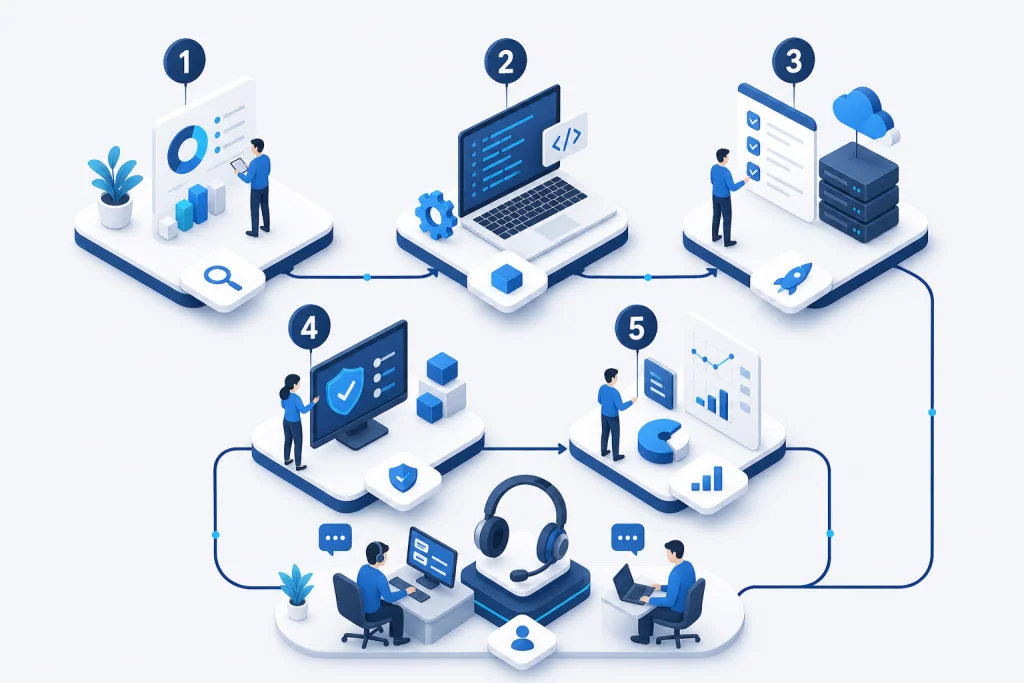
A modern warehouse automation architecture comprises multiple layers: hardware, control systems, and software. The hardware layer includes AMRs (e.g., from Geek+ or Locus Robotics), conveyor systems, and automated guided vehicles (AGVs). These are controlled by a centralized Warehouse Control System (WCS) that communicates via industrial IoT protocols. The IT backbone relies on high-bandwidth networking from Cisco to ensure real-time data transmission between devices and the WMS. Edge servers from HP process data locally to reduce latency, while Synology NAS units provide redundant storage for logs and analytics. The WMS, often integrated with ERP systems like SAP or Oracle, orchestrates inventory management, order fulfillment, and labor scheduling. For cybersecurity, Fortinet firewalls protect the OT network from threats. This architecture supports scalability, allowing enterprises to add robotic fleets or expand storage without overhauling the entire system.
Key components include a cloud-based analytics platform (e.g., Microsoft Azure) for predictive maintenance and performance dashboards. The system uses RFID and barcode scanners for item-level tracking, with data aggregated in a data lake for AI-driven insights. Redundancy is built in via failover servers and UPS units to ensure 99.9% uptime. This architecture reduces manual intervention by 70% and improves inventory accuracy to 99.5%.
Industry Use Cases for Warehouse Automation
In the FMCG sector, warehouse automation enables high-speed order picking for perishable goods, reducing spoilage by 15% and increasing throughput by 30%. For example, a large distributor in Jakarta deployed AMRs and automated palletizing systems, cutting labor costs by 40%. In automotive manufacturing, automated storage and retrieval systems (AS/RS) manage thousands of SKUs, ensuring just-in-time delivery to assembly lines. This reduces inventory holding costs by 25% and eliminates stockouts. E-commerce fulfillment centers benefit from goods-to-person systems, where robots bring shelves to pickers, achieving 99.9% order accuracy and 50% faster processing times. Pharmaceutical warehouses require strict environmental monitoring; IoT sensors integrated with hyperconverged infrastructure ensure temperature compliance and audit trails. These use cases demonstrate how automation adapts to specific industry needs, driving ROI through efficiency gains and error reduction.
Retail enterprises in Indonesia are adopting automation for omnichannel fulfillment, merging online and store inventory. For instance, a fashion retailer uses AMRs to handle returns and restocking, reducing processing time from 2 hours to 30 minutes. Cold chain logistics rely on automated cold storage with robotic picking, maintaining temperatures between 2-8°C. These implementations highlight the versatility of warehouse automation across sectors.
Warehouse Automation vs Traditional Alternatives
Traditional warehouses rely on manual processes, forklifts, and paper-based tracking, leading to error rates of 3-5% and labor costs comprising 60% of operational expenses. Automation reduces errors to under 0.1% and cuts labor costs by 50-70%. While initial investment is higher, the payback period is typically 2-3 years due to increased throughput and accuracy. For example, a manual system can handle 100 picks per hour per worker, whereas an automated goods-to-person system achieves 400 picks per hour. Automation also improves space utilization by 30-40% through vertical storage and optimized layouts. However, traditional methods offer flexibility for low-volume, high-mix operations. Enterprises should consider hybrid models, using automation for high-volume SKUs and manual for exceptions. IT infrastructure plays a critical role; traditional setups may lack the connectivity and power required for automation. Hyperconverged infrastructure from VMware simplifies management and scales easily, unlike legacy systems.
Maintenance differs: traditional equipment like forklifts require frequent repairs, while AMRs have predictive maintenance via IoT sensors, reducing downtime by 20%. Security also improves; automated systems track every movement, reducing theft. Overall, automation offers superior ROI for high-volume enterprises, while traditional methods remain viable for small-scale operations.
Case Study & Implementation Methodology
A food & beverage company in Surabaya faced 8% order errors and 35% labor turnover. Challenge: Manual picking led to 12% overtime costs. Solution: Deployed 20 AMRs from Geek+, integrated with a WMS on server & storage from Dell, and Cisco networking for real-time tracking. Result: Error rate dropped to 0.5%, throughput increased 45%, labor costs reduced 30%, and ROI achieved in 18 months. Implementation followed a phased methodology: assessment, pilot, scaling, and optimization. Phase 1: Audit existing processes and IT infrastructure, including HCI readiness. Phase 2: Pilot with 5 AMRs in a single zone, measuring KPIs. Phase 3: Full deployment with training and change management. Phase 4: Continuous improvement using analytics from Microsoft Power BI. Key success factors include executive sponsorship, cross-functional teams, and vendor partnerships. This methodology ensures minimal disruption and maximum adoption.
Another case: A logistics provider in Jakarta implemented automated sortation and AS/RS for 50,000 SKUs. Challenge: Space constraints and 15% mis-shipments. Solution: Integrated networking from Ruijie and backup from Veeam. Result: Storage capacity increased 60%, mis-shipments reduced to 0.2%, and order cycle time cut by 50%. These examples demonstrate tangible benefits and best practices for enterprise warehouse automation in Indonesia.