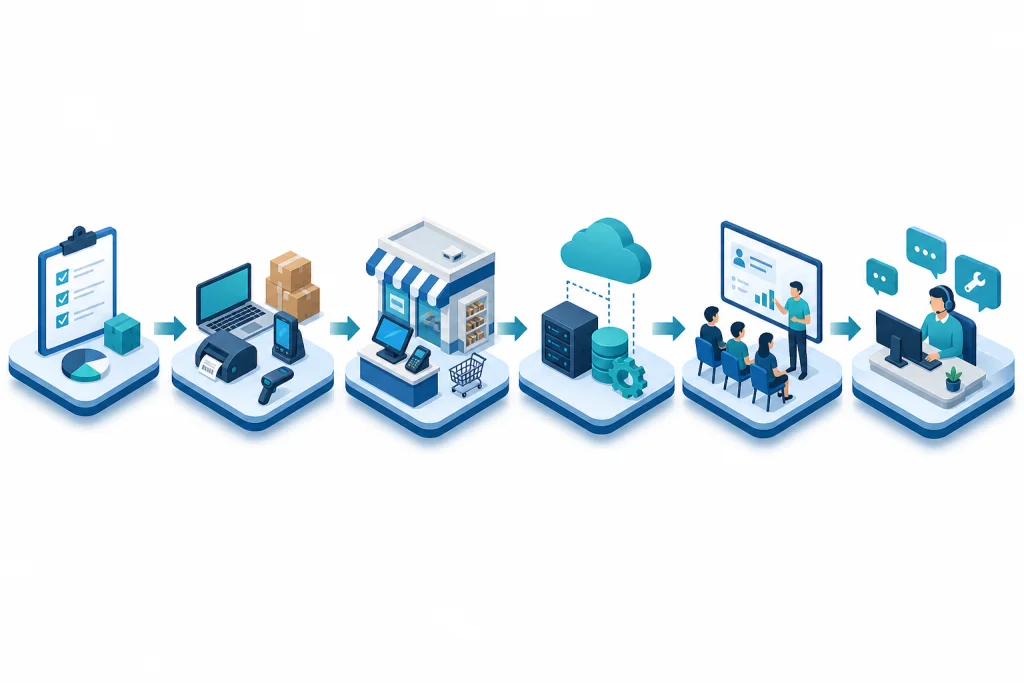
Barcode Scanner Solution Architecture
A typical enterprise barcode scanner architecture consists of three layers: the device layer, the connectivity layer, and the application layer. At the device layer, scanners can be categorized into handheld (e.g., Zebra DS2208), wearable (e.g., Honeywell 8650), and fixed-mount (e.g., Datalogic Matrix 320) models. These devices capture barcodes using laser or imager technologies, with imagers being preferred for 2D codes and damaged labels. The connectivity layer uses Bluetooth, Wi-Fi, or USB to transmit data to a host system. For real-time applications, Wi-Fi or Bluetooth with a dedicated access point is recommended. The application layer includes middleware that parses barcode data and feeds it into ERP or WMS systems. For example, server and storage infrastructure may host the middleware and database. Additionally, networking components like switches and access points ensure low-latency data transmission. Security is paramount; scanners should support encryption (e.g., WPA2-Enterprise) and integrate with cybersecurity solutions to prevent data breaches. In Indonesia, enterprises often deploy ruggedized scanners with IP65 ratings to withstand dust and humidity in warehouses. The architecture must also support scalability, allowing addition of scanners without network redesign.
Industry Use Cases for Barcode Scanner Solution
Barcode scanners are deployed across multiple industries in Indonesia. In logistics and warehousing, they enable real-time tracking of inbound and outbound shipments, reducing processing time by 50%. For example, a 3PL company in Jakarta uses Zebra MC9300 mobile computers to scan pallets, updating their WMS instantly. In manufacturing, barcode scanners track work-in-progress (WIP) and finished goods, ensuring quality control. A automotive parts manufacturer in Bekasi integrated Honeywell Xenon 1900 scanners with their hyperconverged infrastructure to achieve 99.9% inventory accuracy. In healthcare, hospitals use barcode scanners for patient identification and medication administration, reducing errors by 90%. A hospital in Surabaya deployed Datalogic Magellan 8300 scanners at nursing stations, linked to their server and storage for patient records. Retail and e-commerce benefit from barcode scanners for omnichannel fulfillment, enabling fast picking and packing. A fashion retailer in Bandung uses handheld scanners to process 10,000 orders daily with 99.7% accuracy. Asset tracking is another critical use case; enterprises scan asset tags to monitor IT equipment, machinery, and vehicles, integrating with backup and disaster recovery systems for data protection.
Barcode Scanner Solution vs Traditional Alternatives
Traditional data entry methods like manual typing or using pen-and-paper are error-prone and slow. Barcode scanners offer a significant leap in accuracy and speed. Manual entry has an error rate of 1 in 300 keystrokes, while barcode scanning reduces that to 1 in 3 million scans. In terms of speed, a trained operator can manually enter 40 characters per minute, whereas a scanner can decode a barcode in under 100 milliseconds. For inventory counts, manual processes take hours or days, while barcode scanning can complete the same task in minutes. Traditional alternatives also lack integration capabilities; barcode scanners can feed data directly into ERP systems via APIs, eliminating transcription errors. For example, a warehouse using manual methods might have 5% inventory discrepancy, leading to stockouts or overstock. With barcode scanning, discrepancy drops to 0.1%. Additionally, modern scanners support multiple symbologies (UPC, Code 128, QR, Data Matrix), whereas manual methods cannot handle 2D codes. From a cost perspective, while barcode scanners require upfront investment, the ROI is realized through labor savings, reduced errors, and improved customer satisfaction. For Indonesian enterprises, adopting barcode scanning is a competitive necessity, especially when integrated with IT infrastructure solutions like Lenovo servers and Cisco networking.
Case Study & Implementation Methodology
**Manufacturing Company in Karawang**
Challenge: 15% inventory inaccuracy causing production delays and $2M annual losses. Manual cycle counts took 40 hours weekly.
Solution: Deployed 50 Zebra DS8178 scanners integrated with SAP ECC via Wavelink Avalanche. Scanners connected to HP servers running the middleware.
Result: Inventory accuracy improved to 99.8%, cycle count time reduced to 4 hours weekly, and production downtime decreased by 70%. **Implementation Methodology**
Our approach follows a five-phase methodology: Assessment, Design, Pilot, Rollout, and Optimization. In Assessment, we analyze current workflows, barcode usage, and infrastructure. For example, we evaluate network readiness using networking audits. In Design, we select appropriate scanners (e.g., ruggedized for warehouse) and define integration points. Pilot phase tests 10 scanners in a controlled environment, measuring scan success rate and user adoption. Rollout involves phased deployment with training. Optimization includes fine-tuning scanner settings and middleware rules. Post-implementation, we provide 24/7 support and regular firmware updates. This methodology ensures minimal disruption and maximum ROI, typically achieving payback within 6 months.