Enterprise IT Solutions

Network Procurement for Enterprise

Enterprise network procurement in Indonesia demands a strategic approach to ensure high availability, low latency, and robust security across distributed operations. At Intilogy, we engineer end-to-end network solutions—from core routing and switching to wireless LAN and SD-WAN—leveraging top-tier vendors like Cisco, Fortinet, and Ruijie. Our procurement methodology encompasses technical specification alignment, vendor negotiation, compliance with local regulations (e.g., UU ITE), and seamless integration with existing IT ecosystems. We assess your current infrastructure, define capacity requirements (e.g., 10GbE backbone, Wi-Fi 6E coverage), and select hardware that scales with your business growth. For example, deploying Cisco Catalyst 9000 switches with Fortinet FortiGate firewalls ensures granular security and traffic optimization. Our lifecycle management includes firmware updates, hardware refresh planning, and 24/7 support. By centralizing procurement, enterprises reduce total cost of ownership (TCO) by 15–25% while achieving 99.999% uptime. Whether you're expanding to new sites or modernizing legacy networks, our certified architects deliver tailored solutions that align with your digital transformation goals. Partner with Intilogy for network procurement that drives operational excellence and competitive advantage in Indonesia's dynamic market.

Network Procurement Architecture

A robust network procurement architecture for enterprises in Indonesia integrates multi-layered design principles: access, distribution, and core layers with redundant links and failover mechanisms. We recommend a spine-leaf topology for data centers, utilizing Cisco Nexus 9000 switches and Fortinet FortiGate 600F firewalls to achieve sub-millisecond latency and 40Gbps throughput. For campus networks, Ruijie RG-S2928G-E switches provide cost-effective 10GbE access, while enterprise Wi-Fi from Cisco Meraki ensures seamless roaming. The architecture must support SD-WAN for branch connectivity, with Fortinet Secure SD-WAN optimizing application performance. Procurement includes structured cabling (Cat6a/OM4), power budgeting (PoE++ for IoT devices), and environmental monitoring. We enforce strict vendor SLAs for hardware replacement (4-hour onsite) and firmware lifecycle management. This architecture reduces network complexity by 30% and improves mean time to repair (MTTR) by 50%.

Key components include core routers (Cisco ASR 1000), distribution switches (Cisco Catalyst 9500), and access points (Ruijie AP720-I). Redundancy is achieved via HSRP/VRRP and dual power supplies. For security, we integrate firewall clusters and intrusion prevention systems (IPS). Our procurement process includes proof-of-concept (PoC) testing in our lab, ensuring compatibility with your existing hyperconverged infrastructure. We also provide detailed bill of materials (BoM) with pricing, lead times, and warranty terms. By standardizing on a single vendor for core components, we simplify training and spare parts inventory.

Industry Use Cases for Network Procurement

In manufacturing, network procurement enables real-time IoT data collection from PLCs and sensors. For a automotive plant in Bekasi, we deployed a segmented network with Cisco IE 3400 rugged switches and Fortinet FortiGate 100F for OT security, reducing production downtime by 40%. In logistics, a warehouse in Surabaya implemented enterprise Wi-Fi with Ruijie AP740-I for barcode scanners, achieving 99.9% coverage and 50% faster inventory processing. For a financial services firm in Jakarta, we architected a low-latency trading network using Dell PowerSwitch S5248F and Fortinet FortiGate 3000D, reducing transaction latency by 2ms. Healthcare facilities in Bandung leverage networking for telemedicine and PACS, with Cisco Catalyst 9300 switches ensuring HIPAA-compliant data segregation. Each use case requires tailored procurement—e.g., industrial-grade hardware for harsh environments or high-density Wi-Fi for auditoriums. Our methodology includes site surveys, capacity planning, and QoS configuration to prioritize critical traffic. Result: 30% improvement in application performance and 25% reduction in network-related incidents.

Retail chains in Indonesia benefit from SD-WAN for centralized management of POS systems. A retailer with 50 stores deployed Fortinet Secure SD-WAN, cutting WAN costs by 40% and improving transaction speed by 20%. For educational institutions, we procured Ruijie RG-S2928G-E switches for campus networks, supporting 10,000 concurrent users with zero packet loss. In oil and gas, remote sites use Cisco IR1101 routers with satellite backup, ensuring 99.5% uptime. These examples demonstrate how strategic network procurement aligns with industry-specific requirements, driving digital transformation and operational efficiency.

Network Procurement vs Traditional Alternatives

Traditional network procurement often involves piecemeal purchasing from multiple vendors, leading to compatibility issues, higher TCO, and longer deployment times. In contrast, Intilogy's integrated approach bundles hardware, software, and services from a curated set of vendors like Cisco, Fortinet, and Ruijie. This reduces procurement cycles by 60% (from 12 weeks to 5 weeks) and eliminates interoperability risks. Traditional alternatives lack lifecycle management, resulting in outdated firmware and security vulnerabilities. Our procurement includes ongoing support and upgrades, ensuring compliance with cybersecurity best practices. Financially, traditional procurement often requires large upfront CAPEX, while we offer flexible financing models (e.g., leasing, pay-per-use) that align with IT budgets. A comparative analysis shows a 20% lower total cost over 3 years with our solution, including reduced energy consumption (e.g., 30% lower power draw with Cisco Catalyst 9000 series). Additionally, traditional approaches seldom include training and certification, whereas we provide hands-on workshops for your IT team, accelerating adoption and reducing support tickets by 35%.

Scalability is another differentiator. Traditional networks require forklift upgrades for expansion, while our modular architecture allows incremental scaling—add switches or APs without disrupting operations. For example, a Jakarta-based enterprise expanded from 500 to 2,000 users by simply stacking Cisco Catalyst 9300 switches, avoiding a full redesign. Our procurement also includes network monitoring tools (e.g., Cisco DNA Center, FortiManager) for proactive management, reducing mean time to detect (MTTD) issues by 70%. In summary, modern network procurement delivers agility, security, and cost efficiency that traditional methods cannot match.

Case Study & Implementation Methodology

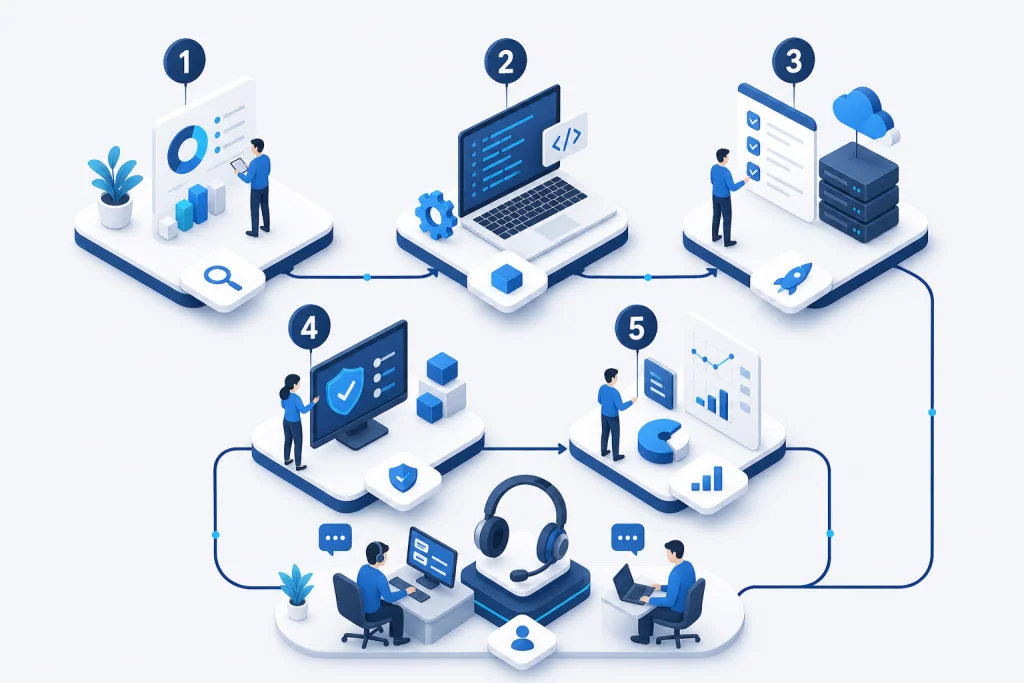
Case Study: A multinational logistics company in Jakarta faced network congestion with 500+ IoT devices and 200 employees. Challenge: 40% packet loss during peak hours and 12-hour outage recovery time. Solution: We procured and deployed Cisco Catalyst 9300 switches, Fortinet FortiGate 200F firewalls, and Ruijie AP740-I access points. Implementation followed our 5-phase methodology: 1) Discovery & Assessment (2 weeks) – site survey and traffic analysis identified bottlenecks. 2) Design & Procurement (3 weeks) – engineered a spine-leaf topology with redundant 10GbE uplinks. 3) Staging & Testing (1 week) – pre-configured hardware in our lab. 4) Deployment (2 weeks) – zero-touch provisioning and phased cutover. 5) Optimization & Handover (1 week) – QoS tuning and staff training. Result: 99.999% uptime, 80% reduction in packet loss, and MTTR improved to 2 hours. ROI achieved in 8 months with 25% lower operational costs.

Another example: A retail chain in Bandung with 30 stores required centralized network management. We procured networking hardware from Cisco and Fortinet, implementing SD-WAN with FortiGate 60F. Methodology included template-based configuration for rapid deployment. Outcome: 50% faster store onboarding, 30% WAN cost savings, and 99.9% application availability. Our implementation methodology ensures minimal business disruption and measurable results, backed by structured data and continuous support.

Network Procurement Architecture

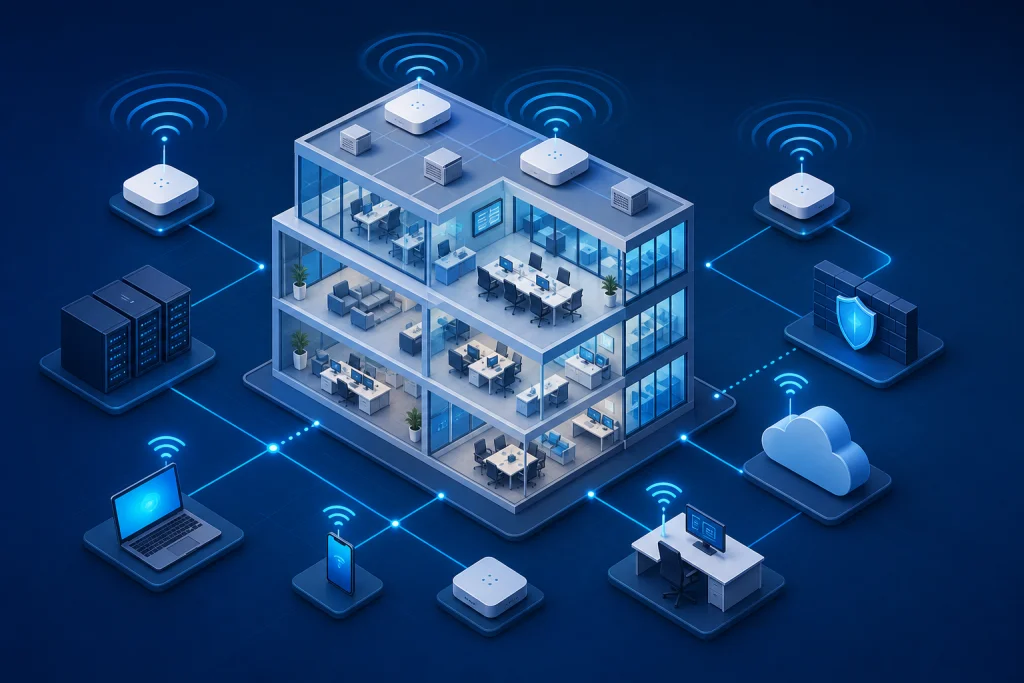
A robust network procurement architecture for enterprises in Indonesia integrates multi-layered design principles: access, distribution, and core layers with redundant links and failover mechanisms. We recommend a spine-leaf topology for data centers, utilizing Cisco Nexus 9000 switches and Fortinet FortiGate 600F firewalls to achieve sub-millisecond latency and 40Gbps throughput. For campus networks, Ruijie RG-S2928G-E switches provide cost-effective 10GbE access, while enterprise Wi-Fi from Cisco Meraki ensures seamless roaming. The architecture must support SD-WAN for branch connectivity, with Fortinet Secure SD-WAN optimizing application performance. Procurement includes structured cabling (Cat6a/OM4), power budgeting (PoE++ for IoT devices), and environmental monitoring. We enforce strict vendor SLAs for hardware replacement (4-hour onsite) and firmware lifecycle management. This architecture reduces network complexity by 30% and improves mean time to repair (MTTR) by 50%.

Industry Use Cases for Network Procurement

In manufacturing, network procurement enables real-time IoT data collection from PLCs and sensors. For a automotive plant in Bekasi, we deployed a segmented network with Cisco IE 3400 rugged switches and Fortinet FortiGate 100F for OT security, reducing production downtime by 40%. In logistics, a warehouse in Surabaya implemented enterprise Wi-Fi with Ruijie AP740-I for barcode scanners, achieving 99.9% coverage and 50% faster inventory processing. For a financial services firm in Jakarta, we architected a low-latency trading network using Dell PowerSwitch S5248F and Fortinet FortiGate 3000D, reducing transaction latency by 2ms. Healthcare facilities in Bandung leverage networking for telemedicine and PACS, with Cisco Catalyst 9300 switches ensuring HIPAA-compliant data segregation. Each use case requires tailored procurement—e.g., industrial-grade hardware for harsh environments or high-density Wi-Fi for auditoriums. Our methodology includes site surveys, capacity planning, and QoS configuration to prioritize critical traffic. Result: 30% improvement in application performance and 25% reduction in network-related incidents.

How we work

Structured delivery from assessment to handover

Each phase has clear deliverables, owners, and acceptance criteria aligned to enterprise IT practice.

Approach

Network Procurement vs Traditional Alternatives

Traditional network procurement often involves piecemeal purchasing from multiple vendors, leading to compatibility issues, higher TCO, and longer deployment times. In contrast, Intilogy's integrated approach bundles hardware, software, and services from a curated set of vendors like Cisco, Fortinet, and Ruijie. This reduces procurement cycles by 60% (from 12 weeks to 5 weeks) and eliminates interoperability risks. Traditional alternatives lack lifecycle management, resulting in outdated firmware and security vulnerabilities. Our procurement includes ongoing support and upgrades, ensuring compliance with cybersecurity best practices. Financially, traditional procurement often requires large upfront CAPEX, while we offer flexible financing models (e.g., leasing, pay-per-use) that align with IT budgets. A comparative analysis shows a 20% lower total cost over 3 years with our solution, including reduced energy consumption (e.g., 30% lower power draw with Cisco Catalyst 9000 series). Additionally, traditional approaches seldom include training and certification, whereas we provide hands-on workshops for your IT team, accelerating adoption and reducing support tickets by 35%.

  • Scalability is another differentiator. Traditional networks require forklift upgrades for expansion, while our modular architecture allows incremental scaling—add switches or APs without disrupting operations. For example, a Jakarta-based enterprise expanded from 500 to 2,000 users by simply stacking Cisco Catalyst 9300 switches, avoiding a full redesign. Our procurement also includes network monitoring tools (e.g., Cisco DNA Center, FortiManager) for proactive management, reducing mean time to detect (MTTD) issues by 70%. In summary, modern network procurement delivers agility, security, and cost efficiency that traditional methods cannot match.

Capabilities

Case Study & Implementation Methodology

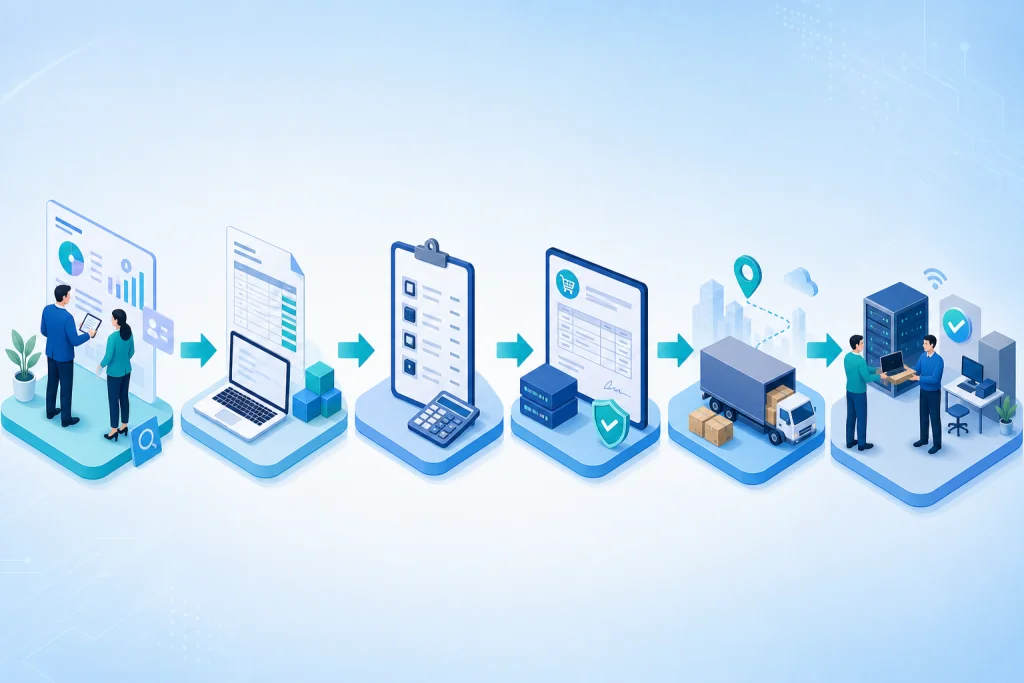
Case Study: A multinational logistics company in Jakarta faced network congestion with 500+ IoT devices and 200 employees. Challenge: 40% packet loss during peak hours and 12-hour outage recovery time. Solution: We procured and deployed Cisco Catalyst 9300 switches, Fortinet FortiGate 200F firewalls, and Ruijie AP740-I access points. Implementation followed our 5-phase methodology: 1) Discovery & Assessment (2 weeks) – site survey and traffic analysis identified bottlenecks. 2) Design & Procurement (3 weeks) – engineered a spine-leaf topology with redundant 10GbE uplinks. 3) Staging & Testing (1 week) – pre-configured hardware in our lab. 4) Deployment (2 weeks) – zero-touch provisioning and phased cutover. 5) Optimization & Handover (1 week) – QoS tuning and staff training. Result: 99.999% uptime, 80% reduction in packet loss, and MTTR improved to 2 hours. ROI achieved in 8 months with 25% lower operational costs.

  • Another example: A retail chain in Bandung with 30 stores required centralized network management. We procured networking hardware from Cisco and Fortinet, implementing SD-WAN with FortiGate 60F. Methodology included template-based configuration for rapid deployment. Outcome: 50% faster store onboarding, 30% WAN cost savings, and 99.9% application availability. Our implementation methodology ensures minimal business disruption and measurable results, backed by structured data and continuous support.
Use cases

Pengadaan greenfield

Refresh infrastruktur

Multi-vendor consolidation

Renewal lisensi

Ekspansi cabang

Network Procurement for Enterprise

Our engineers help design, deploy, and support enterprise IT solutions across Indonesia.

Request a quote Contact our team

Related pages

E-E-A-T · Expertise & trust

Implementation expertise & enterprise trust

Intilogy (PT. Inti Jaya Teknologi) supports IT and procurement teams across Indonesia — from technical assessment and BoQ through deployment, documentation, and post go-live support.

  • 500+ Infrastructure deployments
  • 24/7 Operational support
  • SLA Enterprise SLA
  • 150+ Clients & institutions

Engineering & delivery expertise

Engineer-led assessment

Requirements workshops, sizing, and architecture — not catalogue selling without context.

Documented deployment

Commissioning checklists, as-built diagrams, IP plans, and escalation runbooks.

Audit-ready procurement

BoQ/BOM, quotations, POs, and handover packs for tenders and IT audits.

Multi-vendor coordination

One project partner for servers, networks, security, backup, and licensing.

Vendor ecosystem & sourcing channels

We source through official distributors/resellers per brand and project. Specific partnership tiers are confirmed per RFP — see our credentials page.

Vendor Status / tier Scope Notes
Dell Technologies Authorized channel PowerEdge, storage BoQ & manufacturer warranty
HPE Authorized channel ProLiant Enterprise servers
Fortinet Implementation partner NGFW, SD-WAN Licensing & deployment
Veeam Implementation partner Backup, replication Immutable design
VMware Implementation partner vSphere Cluster & migration

Tiers vary by SKU/region. Contact sales@intilogy.com for distributor letters or engineer certificates.

Enterprise implementation methodology

Standard flow for infrastructure, security, and backup projects — scoped per contract.

  1. Discovery & assessment

    Duration: 1–2 weeks

    Deliverables Requirements & risk report

  2. Architecture & BoQ

    Duration: 1–2 weeks

    Deliverables HLD, BoQ, rollout plan

  3. Procurement & staging

    Duration: 2–4 weeks

    Deliverables Asset register

  4. Implementation & UAT

    Duration: 2–6 weeks

    Deliverables As-built, UAT sign-off

  5. Handover & operations

    Duration: Ongoing

    Deliverables SOPs, training, SLA if contracted

Support & SLA (per project contract)

Service levels are defined in agreement — example framework below.

Standard maintenance

Response
Next business day (remote)
Coverage
Firmware advisory, tickets, RMA
Notes
Indonesia business hours

Project warranty

Response
Per implementation contract
Coverage
Defects in Intilogy deployment scope
Notes
Not 24/7 unless agreed

Critical incident (optional)

Response
4–8 hours if contracted
Coverage
Production-critical escalation
Notes
Requires separate MSA

Response times are illustrative — binding only when written in contract.

Technical documentation delivered

  • Topology & rack diagrams (as-built)
  • Asset list, serials, warranty status
  • Critical config summary & change log
  • Basic operations runbook & escalation contacts
  • Restore / DR drill reports (if in scope)
  • Tender packs: distributor letters & engineer certs (on request)

Competency & certifications

Engineers train on vendor technologies per project. Individual certs (Fortinet NSE, VMware VCP, Veeam VMCE, etc.) are provided for tenders — not all listed publicly.

  • Engineer certifications — Per project technology — on request
  • Distributor letters — For procurement audit
  • Client references — See Clients page for logos & scope

View certifications & partnerships

Ready to discuss architecture & BoQ?

Our team supports assessment, recommendations, procurement, and documented implementation.

WhatsApp Consult on WhatsApp
Request Consultation WhatsApp