Enterprise IT Solutions

IT Procurement for Enterprise

Enterprise IT procurement in Indonesia involves strategic sourcing of hardware, software, and services to support business operations, scalability, and security. Unlike ad-hoc purchasing, a structured procurement process aligns technology investments with organizational goals, ensuring cost efficiency, vendor management, and compliance with local regulations. Key components include network infrastructure from Cisco and Ruijie, server and storage solutions from Lenovo, HP, and Dell, cybersecurity tools from Fortinet, and backup systems from Veeam. Effective procurement also covers licensing for Microsoft and VMware, as well as hybrid cloud deployments. In Indonesia, enterprises face unique challenges such as import duties, local content requirements, and varying lead times. A robust procurement strategy mitigates risks, reduces total cost of ownership (TCO), and ensures technology alignment with business continuity plans. This article explores IT procurement architecture, industry use cases, comparisons with traditional alternatives, and a data-driven implementation methodology.

IT Procurement Architecture

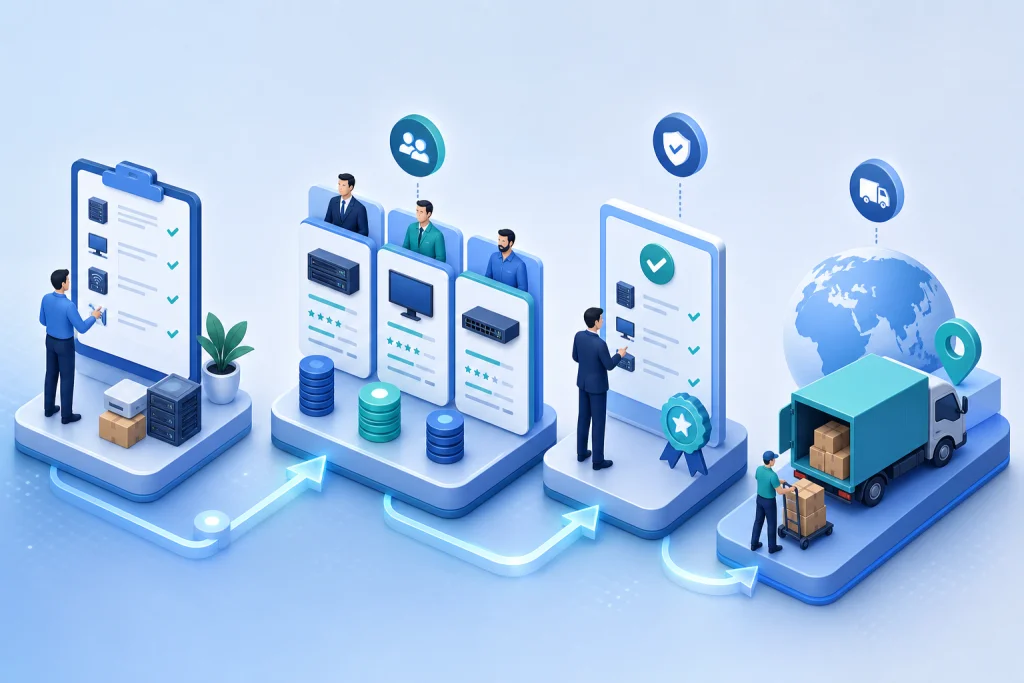
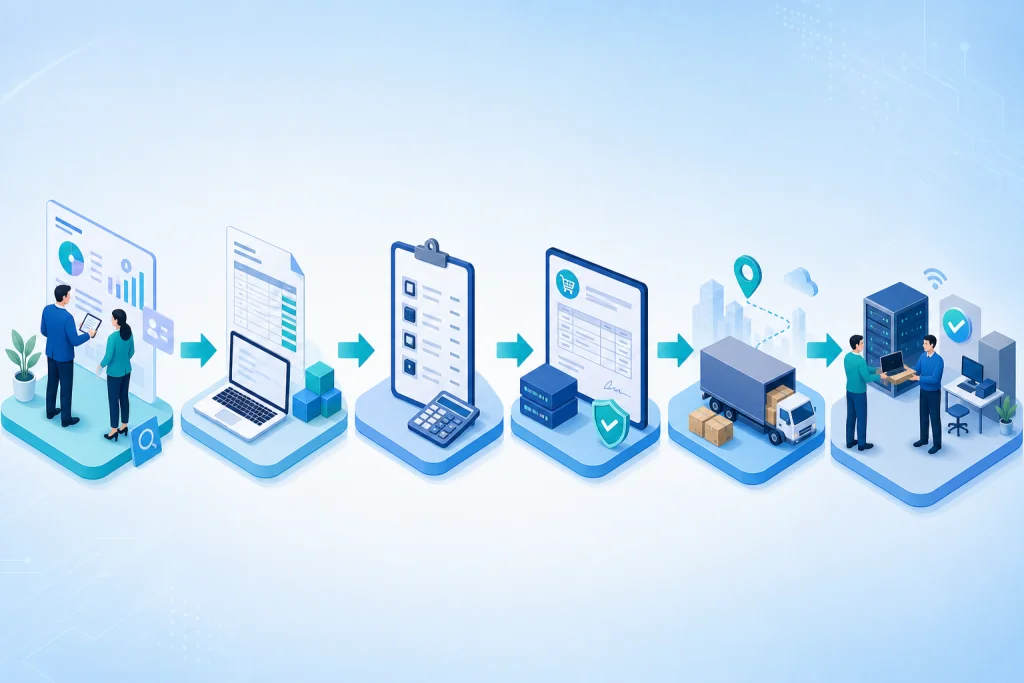
A robust IT procurement architecture comprises several layers: demand management, vendor selection, contract negotiation, order fulfillment, and asset lifecycle management. The process begins with a needs assessment, where IT teams define technical specifications, performance metrics, and compliance requirements. For example, a typical enterprise may require server and storage solutions from Lenovo or Dell, networking gear from Cisco or Ruijie, and cybersecurity appliances from Fortinet. Each vendor is evaluated based on TCO, support SLAs, and integration capabilities.

The procurement architecture also includes a centralized procurement system (e.g., ERP or e-procurement platform) that automates purchase orders, approvals, and inventory tracking. In Indonesia, enterprises must consider local regulations such as Tingkat Komponen Dalam Negeri (TKDN) for certain products. A well-designed architecture ensures compliance while optimizing costs through bulk purchasing and strategic partnerships. Post-procurement, asset management tools track warranties, licenses, and refresh cycles, integrating with backup and disaster recovery plans to maintain business continuity.

Industry Use Cases for IT Procurement

In the manufacturing sector, IT procurement supports the deployment of IoT sensors, edge computing, and MES systems. For instance, a automotive plant in Jakarta procured Dell servers and Cisco switches to enable real-time production monitoring, resulting in a 15% increase in OEE. Similarly, in healthcare, hospitals require HIPAA-compliant storage from Synology and cybersecurity from Fortinet to protect patient data. A hospital in Surabaya implemented a Veeam backup solution alongside QNAP NAS, reducing data recovery time by 80%.

Retail enterprises leverage IT procurement for omnichannel platforms. A retail chain in Bandung procured HPE servers and VMware virtualization to support its e-commerce platform, handling 50,000 transactions daily during peak season. Financial institutions prioritize compliance; a bank in Jakarta acquired Fortinet firewalls and Microsoft 365 E5 licenses to meet OJK regulations. These use cases demonstrate how tailored procurement drives operational efficiency and regulatory adherence.

IT Procurement vs Traditional Alternatives

Traditional IT procurement often involves ad-hoc purchasing from multiple vendors without centralized coordination, leading to higher costs, compatibility issues, and longer lead times. In contrast, structured enterprise procurement leverages strategic sourcing and standardization. For example, buying Lenovo servers individually from different resellers may result in inconsistent configurations and higher per-unit costs. A consolidated procurement approach with a single partner like Intilogy ensures volume discounts, warranty consolidation, and simplified logistics.

Another key difference is lifecycle management. Traditional methods often neglect asset disposal and renewal, causing security risks from outdated hardware. Enterprise procurement integrates with IT infrastructure planning, including regular refresh cycles and end-of-life management. Additionally, traditional procurement rarely includes software license optimization, leading to overspending. With enterprise procurement, tools like Microsoft licensing advisor and VMware true-up services are used to right-size licenses, reducing costs by up to 20%.

Case Study & Implementation Methodology

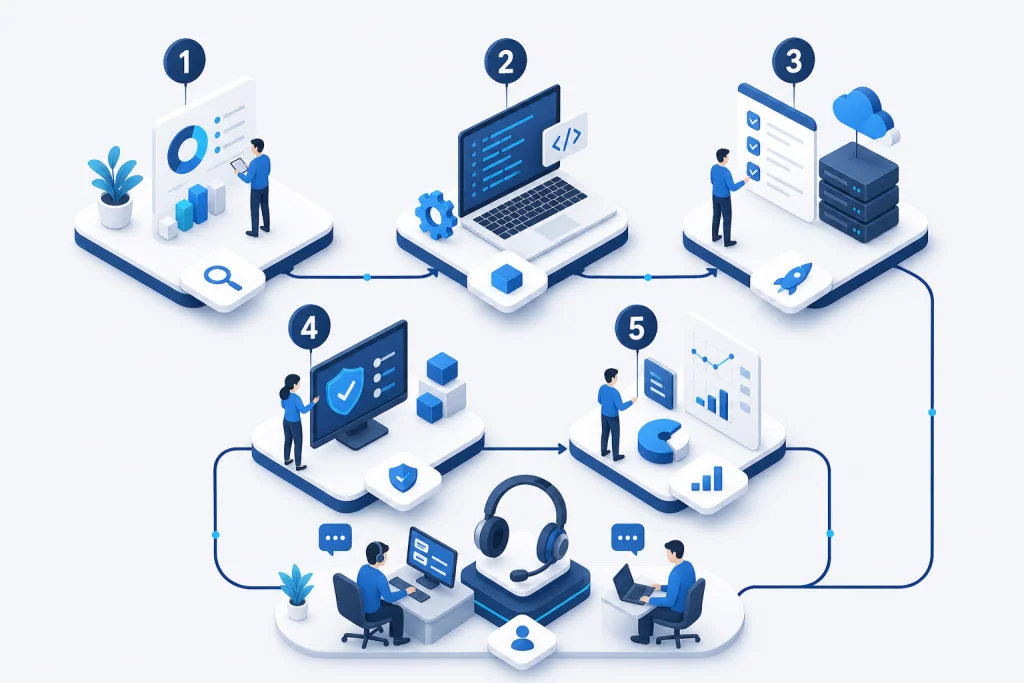
A logistics company in Jakarta faced challenges with aging network infrastructure causing 12% packet loss and 3-hour weekly downtime. Challenge: Outdated Cisco switches and unmanaged Wi-Fi led to 40% slower warehouse operations. Solution: Intilogy deployed a new network architecture with Ruijie switches and enterprise Wi-Fi, integrated with HCI from Dell for edge compute. Result: 99.9% network uptime, 30% improvement in warehouse throughput, and 25% reduction in IT support tickets. The implementation followed a phased methodology: assessment, design, procurement, deployment, and optimization.

Another case: An e-commerce company in Surabaya needed to scale its server capacity for a 200% traffic surge during Ramadan. Challenge: Existing HP servers reached 90% CPU utilization, causing slow page loads. Solution: Procured additional HP ProLiant servers and VMware vSphere licenses through Intilogy, with a hybrid cloud setup for burst capacity. Result: 50% faster page load times, 99.99% uptime during peak, and 15% lower TCO compared to public cloud-only. The methodology included capacity planning, vendor negotiation, and staged deployment to avoid disruption.

IT Procurement Architecture

A robust IT procurement architecture comprises several layers: demand management, vendor selection, contract negotiation, order fulfillment, and asset lifecycle management. The process begins with a needs assessment, where IT teams define technical specifications, performance metrics, and compliance requirements. For example, a typical enterprise may require server and storage solutions from Lenovo or Dell, networking gear from Cisco or Ruijie, and cybersecurity appliances from Fortinet. Each vendor is evaluated based on TCO, support SLAs, and integration capabilities.

Industry Use Cases for IT Procurement

In the manufacturing sector, IT procurement supports the deployment of IoT sensors, edge computing, and MES systems. For instance, a automotive plant in Jakarta procured Dell servers and Cisco switches to enable real-time production monitoring, resulting in a 15% increase in OEE. Similarly, in healthcare, hospitals require HIPAA-compliant storage from Synology and cybersecurity from Fortinet to protect patient data. A hospital in Surabaya implemented a Veeam backup solution alongside QNAP NAS, reducing data recovery time by 80%.

How we work

Structured delivery from assessment to handover

Each phase has clear deliverables, owners, and acceptance criteria aligned to enterprise IT practice.

Approach

IT Procurement vs Traditional Alternatives

Traditional IT procurement often involves ad-hoc purchasing from multiple vendors without centralized coordination, leading to higher costs, compatibility issues, and longer lead times. In contrast, structured enterprise procurement leverages strategic sourcing and standardization. For example, buying Lenovo servers individually from different resellers may result in inconsistent configurations and higher per-unit costs. A consolidated procurement approach with a single partner like Intilogy ensures volume discounts, warranty consolidation, and simplified logistics.

  • Another key difference is lifecycle management. Traditional methods often neglect asset disposal and renewal, causing security risks from outdated hardware. Enterprise procurement integrates with IT infrastructure planning, including regular refresh cycles and end-of-life management. Additionally, traditional procurement rarely includes software license optimization, leading to overspending. With enterprise procurement, tools like Microsoft licensing advisor and VMware true-up services are used to right-size licenses, reducing costs by up to 20%.

Capabilities

Case Study & Implementation Methodology

A logistics company in Jakarta faced challenges with aging network infrastructure causing 12% packet loss and 3-hour weekly downtime. Challenge: Outdated Cisco switches and unmanaged Wi-Fi led to 40% slower warehouse operations. Solution: Intilogy deployed a new network architecture with Ruijie switches and enterprise Wi-Fi, integrated with HCI from Dell for edge compute. Result: 99.9% network uptime, 30% improvement in warehouse throughput, and 25% reduction in IT support tickets. The implementation followed a phased methodology: assessment, design, procurement, deployment, and optimization.

  • Another case: An e-commerce company in Surabaya needed to scale its server capacity for a 200% traffic surge during Ramadan. Challenge: Existing HP servers reached 90% CPU utilization, causing slow page loads. Solution: Procured additional HP ProLiant servers and VMware vSphere licenses through Intilogy, with a hybrid cloud setup for burst capacity. Result: 50% faster page load times, 99.99% uptime during peak, and 15% lower TCO compared to public cloud-only. The methodology included capacity planning, vendor negotiation, and staged deployment to avoid disruption.
IT Procurement for Enterprise

Our engineers help design, deploy, and support enterprise IT solutions across Indonesia.

Request a quote Contact our team

Case studies

Studi Kasus Terkait

Proyek nyata di lapangan — tantangan spesifik, solusi terukur, dan hasil yang terdokumentasi.

Hybrid Cloud for Government Agency

Industry Government

Challenge Data classification limited which workloads could use cloud. The IT team had limited hybrid operations experience.

Result More elastic portal capacity at service peaks; sensitive data remained on-premise per policy.

Transforming Industrial Safety & Efficiency with Edge AI Computer Vision

Industry Industrial / Mining / Manufacturing / Logistics

Challenge Managing expansive heavy industry environments inherently creates operational blind spots. Workplace accidents and asset breakdowns occur because human supervisors cannot constantly monitor thousands of critical points i

Result The implementation of this Computer Vision ecosystem delivered a measurable Return on Investment (ROI) in under six months:

Manufacturing Data Center Refresh

Industry Manufacturing

Challenge Servers neared end of life; critical VMs restarted due to storage latency.

Result Improved production application stability; database backup RPO met plant management targets.

Disaster Recovery Readiness for Government Agency

Industry Government

Challenge Backup jobs ran successfully but there was no evidence of successful restores. RPO/RTO were not agreed with application owners.

Result IT gained tested recovery procedures, documented RPO/RTO, and significantly improved restore confidence.

Firewall Upgrade for Financial Institution

Industry Financial Services

Challenge Legacy firewall rules were undocumented; years of ad-hoc changes accumulated. Audits required proof of segmentation and centralized logging.

Result Documented policies, improved incident visibility, and branch migrations without critical operational outages.

Storage Modernization for a National Retailer

Industry Retail

Challenge Operational data volume grew every quarter. Night backups often missed their window due to limited capacity and bandwidth. Cross-department file access was poorly controlled.

Result Backup windows shortened significantly, file access was more stable at peak hours, and IT had clear recovery procedures.

Corporate Endpoint Refresh

Industry Enterprise

Challenge Mixed specs per branch, slow onboarding, and decentralized warranty tracking.

Result Faster new-hire onboarding and more predictable support costs.

Related pages

E-E-A-T · Expertise & trust

Implementation expertise & enterprise trust

Intilogy (PT. Inti Jaya Teknologi) supports IT and procurement teams across Indonesia — from technical assessment and BoQ through deployment, documentation, and post go-live support.

  • 500+ Infrastructure deployments
  • 24/7 Operational support
  • SLA Enterprise SLA
  • 150+ Clients & institutions

Engineering & delivery expertise

Engineer-led assessment

Requirements workshops, sizing, and architecture — not catalogue selling without context.

Documented deployment

Commissioning checklists, as-built diagrams, IP plans, and escalation runbooks.

Audit-ready procurement

BoQ/BOM, quotations, POs, and handover packs for tenders and IT audits.

Multi-vendor coordination

One project partner for servers, networks, security, backup, and licensing.

Vendor ecosystem & sourcing channels

We source through official distributors/resellers per brand and project. Specific partnership tiers are confirmed per RFP — see our credentials page.

Vendor Status / tier Scope Notes
Dell Technologies Authorized channel PowerEdge, storage BoQ & manufacturer warranty
HPE Authorized channel ProLiant Enterprise servers
Fortinet Implementation partner NGFW, SD-WAN Licensing & deployment
Veeam Implementation partner Backup, replication Immutable design
VMware Implementation partner vSphere Cluster & migration

Tiers vary by SKU/region. Contact sales@intilogy.com for distributor letters or engineer certificates.

Enterprise implementation methodology

Standard flow for infrastructure, security, and backup projects — scoped per contract.

  1. Discovery & assessment

    Duration: 1–2 weeks

    Deliverables Requirements & risk report

  2. Architecture & BoQ

    Duration: 1–2 weeks

    Deliverables HLD, BoQ, rollout plan

  3. Procurement & staging

    Duration: 2–4 weeks

    Deliverables Asset register

  4. Implementation & UAT

    Duration: 2–6 weeks

    Deliverables As-built, UAT sign-off

  5. Handover & operations

    Duration: Ongoing

    Deliverables SOPs, training, SLA if contracted

Support & SLA (per project contract)

Service levels are defined in agreement — example framework below.

Standard maintenance

Response
Next business day (remote)
Coverage
Firmware advisory, tickets, RMA
Notes
Indonesia business hours

Project warranty

Response
Per implementation contract
Coverage
Defects in Intilogy deployment scope
Notes
Not 24/7 unless agreed

Critical incident (optional)

Response
4–8 hours if contracted
Coverage
Production-critical escalation
Notes
Requires separate MSA

Response times are illustrative — binding only when written in contract.

Technical documentation delivered

  • Topology & rack diagrams (as-built)
  • Asset list, serials, warranty status
  • Critical config summary & change log
  • Basic operations runbook & escalation contacts
  • Restore / DR drill reports (if in scope)
  • Tender packs: distributor letters & engineer certs (on request)

Competency & certifications

Engineers train on vendor technologies per project. Individual certs (Fortinet NSE, VMware VCP, Veeam VMCE, etc.) are provided for tenders — not all listed publicly.

  • Engineer certifications — Per project technology — on request
  • Distributor letters — For procurement audit
  • Client references — See Clients page for logos & scope

View certifications & partnerships

Ready to discuss architecture & BoQ?

Our team supports assessment, recommendations, procurement, and documented implementation.

WhatsApp Consult on WhatsApp
Request Consultation WhatsApp