Enterprise IT Solutions

Enterprise CCTV for Business

Enterprise CCTV systems are no longer simple analog cameras; they are integral components of a modern security architecture that leverages high-resolution imaging, edge computing, and artificial intelligence to deliver real-time threat detection and operational intelligence. In Indonesia, where businesses face unique challenges such as high humidity, temperature fluctuations, and expansive warehouse layouts, deploying a robust enterprise CCTV solution requires careful consideration of network infrastructure, storage capacity, and video analytics. At Intilogy, we design and implement end-to-end surveillance ecosystems that integrate seamlessly with existing IT frameworks, including networking and server & storage solutions. Our approach ensures high availability, low latency, and compliance with local data protection regulations. We partner with leading vendors such as Synology for NVR appliances, QNAP for scalable storage, and major camera manufacturers like Hikvision and Axis to deliver 4K, H.265+ compressed video streams that reduce bandwidth consumption by up to 50%. Whether it's for a multi-site retail chain, a manufacturing plant, or a corporate headquarters, our enterprise CCTV solutions provide centralized management, advanced motion detection, and integration with access control systems. This not only enhances security but also enables data-driven decision-making through heat mapping and people counting. By leveraging hybrid cloud architectures, we offer cost-effective offsite backup and remote monitoring, ensuring business continuity even in the event of local hardware failure. Intilogy's enterprise CCTV solutions are built for scalability, supporting thousands of cameras across distributed sites with unified management via VMS platforms like Milestone and Genetec.

Enterprise CCTV Architecture

A robust enterprise CCTV architecture is built on three pillars: high-performance cameras, resilient network infrastructure, and intelligent storage. Cameras should support at least 4K resolution with H.265+ compression to minimize bandwidth while maintaining forensic detail. For indoor environments, fixed dome cameras with IR illumination are common, while outdoor areas require vandal-proof bullet cameras with IP67 ratings. Edge analytics capabilities, such as line crossing and intrusion detection, reduce server load by processing events locally. The network backbone must be designed with enterprise-grade switches that support PoE+ (Power over Ethernet Plus) to deliver both data and power over a single cable, simplifying installation. Redundant uplinks and VLAN segmentation ensure that video traffic does not interfere with business operations. Storage is typically handled by NVRs (Network Video Recorders) or SAN-based solutions. For example, Synology NVRs offer RAID protection, hot-swappable drives, and integration with their Surveillance Station software for centralized management. Alternatively, QNAP NAS devices can be configured as iSCSI targets for high-availability clusters. To calculate storage requirements, use the formula: (Bitrate in Mbps × 3600 seconds × 24 hours × retention days) / 8 = total GB. For a 100-camera system recording 4K at 15fps with 30-day retention, you would need approximately 180TB of usable storage. Cloud integration via hybrid architectures allows for offsite backup and remote access, with failover to local storage during internet outages.

Industry Use Cases for Enterprise CCTV

Enterprise CCTV systems are deployed across diverse industries in Indonesia to solve specific operational challenges. In manufacturing and warehousing, cameras with AI analytics monitor production lines for defects, track inventory movement, and ensure worker safety by detecting unauthorized access to hazardous zones. For example, a logistics company in Jakarta reduced inventory shrinkage by 40% using license plate recognition and RFID integration. In retail, enterprise CCTV enables people counting and heat mapping to optimize store layouts and staffing. A mall operator in Surabaya leveraged this data to increase foot traffic conversion by 15%. For corporate offices, facial recognition and badge integration streamline visitor management while preventing tailgating. Healthcare facilities use CCTV to monitor patient rooms and restricted areas, ensuring HIPAA compliance and safety. In the hospitality sector, cameras with audio analytics detect noise complaints and alert security. All these use cases rely on seamless integration with existing IT systems, such as backup and disaster recovery solutions to ensure video data is protected. Additionally, linking to cybersecurity is critical to prevent unauthorized access to camera feeds, especially when systems are exposed to the internet.

Enterprise CCTV vs Traditional Alternatives

Traditional analog CCTV systems, while lower in upfront cost, suffer from significant limitations in resolution (typically D1 at 720x480), scalability, and intelligence. They require coaxial cabling and separate power lines, increasing installation complexity and cost for large deployments. In contrast, enterprise IP-based systems offer 4K resolution, PoE simplicity, and advanced analytics. Analog systems lack the ability to integrate with other enterprise software, such as access control or video management platforms. Maintenance is also more cumbersome, as each camera must be individually tuned. Enterprise systems provide centralized firmware updates, remote diagnostics, and health monitoring. From a storage perspective, analog DVRs use outdated compression (MJPEG) leading to higher storage costs per camera. Modern enterprise NVRs support H.265+, reducing storage needs by up to 50%. Furthermore, traditional systems have limited cybersecurity features, making them vulnerable to tampering. Enterprise solutions incorporate encryption, user authentication, and audit trails, aligning with cybersecurity best practices. When considering total cost of ownership (TCO), enterprise systems often prove more economical due to lower cabling costs, reduced maintenance, and longer lifespan. For businesses in Indonesia looking to future-proof their security, investing in enterprise CCTV is a strategic decision that pays dividends in operational efficiency and risk mitigation.

Case Study & Implementation Methodology

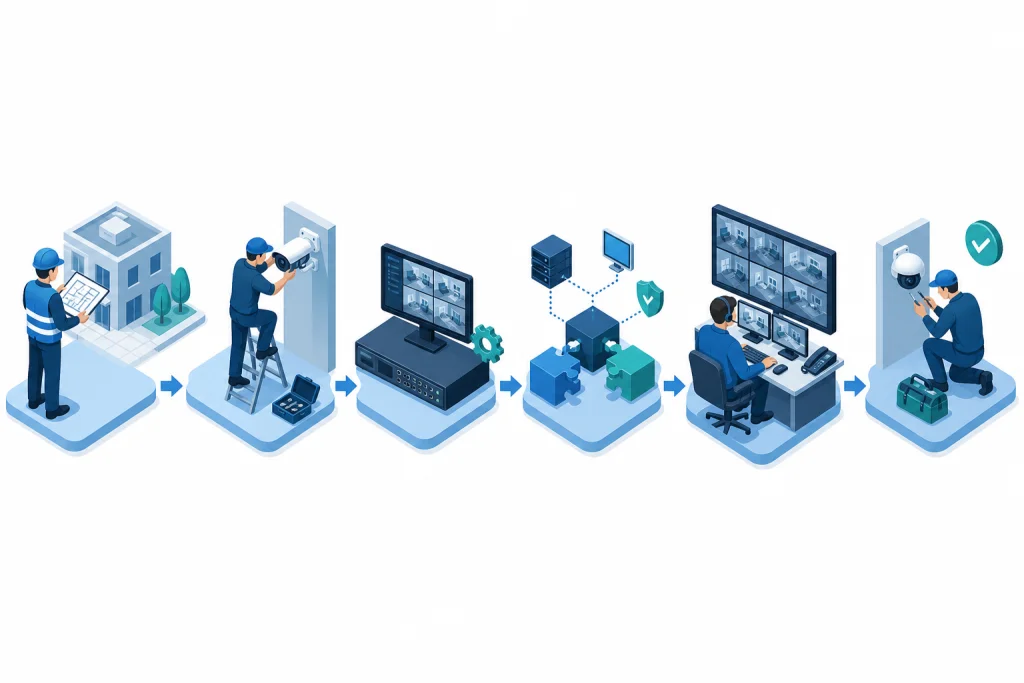
Implementation of an enterprise CCTV system follows a structured methodology: assessment, design, deployment, and optimization. In a recent project for a manufacturing company in Bekasi, the challenge was monitoring a 50,000 sqm facility with 200 cameras while integrating with existing access control. The solution deployed 200 4K H.265+ cameras from Hikvision, connected via a redundant network using Cisco switches with PoE+. Storage was provided by two Synology NVRs in a high-availability cluster, offering 120TB RAID6 storage with 60-day retention. Video analytics included line crossing and intrusion detection, reducing false alarms by 80%. The result: a 30% reduction in security personnel costs, 95% uptime, and compliance with ISO 27001. Another case involved a retail chain in Bandung with 50 stores. The challenge was inconsistent video quality and high bandwidth costs. The solution deployed edge-analytics cameras from Axis with local recording on QNAP NAS at each store, with cloud backup for critical events. This reduced bandwidth usage by 70% and storage costs by 40%. The methodology included a site survey, bandwidth calculation, and VLAN design. Post-deployment, we conducted a 2-week optimization phase to fine-tune motion detection zones and retention policies. Ongoing support includes firmware updates and cybersecurity audits, ensuring the system remains resilient against threats.

Enterprise CCTV Architecture

A robust enterprise CCTV architecture is built on three pillars: high-performance cameras, resilient network infrastructure, and intelligent storage. Cameras should support at least 4K resolution with H.265+ compression to minimize bandwidth while maintaining forensic detail. For indoor environments, fixed dome cameras with IR illumination are common, while outdoor areas require vandal-proof bullet cameras with IP67 ratings. Edge analytics capabilities, such as line crossing and intrusion detection, reduce server load by processing events locally. The network backbone must be designed with enterprise-grade switches that support PoE+ (Power over Ethernet Plus) to deliver both data and power over a single cable, simplifying installation. Redundant uplinks and VLAN segmentation ensure that video traffic does not interfere with business operations. Storage is typically handled by NVRs (Network Video Recorders) or SAN-based solutions. For example, Synology NVRs offer RAID protection, hot-swappable drives, and integration with their Surveillance Station software for centralized management. Alternatively, QNAP NAS devices can be configured as iSCSI targets for high-availability clusters. To calculate storage requirements, use the formula: (Bitrate in Mbps × 3600 seconds × 24 hours × retention days) / 8 = total GB. For a 100-camera system recording 4K at 15fps with 30-day retention, you would need approximately 180TB of usable storage. Cloud integration via hybrid architectures allows for offsite backup and remote access, with failover to local storage during internet outages.

Industry Use Cases for Enterprise CCTV

Enterprise CCTV systems are deployed across diverse industries in Indonesia to solve specific operational challenges. In manufacturing and warehousing, cameras with AI analytics monitor production lines for defects, track inventory movement, and ensure worker safety by detecting unauthorized access to hazardous zones. For example, a logistics company in Jakarta reduced inventory shrinkage by 40% using license plate recognition and RFID integration. In retail, enterprise CCTV enables people counting and heat mapping to optimize store layouts and staffing. A mall operator in Surabaya leveraged this data to increase foot traffic conversion by 15%. For corporate offices, facial recognition and badge integration streamline visitor management while preventing tailgating. Healthcare facilities use CCTV to monitor patient rooms and restricted areas, ensuring HIPAA compliance and safety. In the hospitality sector, cameras with audio analytics detect noise complaints and alert security. All these use cases rely on seamless integration with existing IT systems, such as backup and disaster recovery solutions to ensure video data is protected. Additionally, linking to cybersecurity is critical to prevent unauthorized access to camera feeds, especially when systems are exposed to the internet.

How we work

Structured delivery from assessment to handover

Each phase has clear deliverables, owners, and acceptance criteria aligned to enterprise IT practice.

Approach

Enterprise CCTV vs Traditional Alternatives

Traditional analog CCTV systems, while lower in upfront cost, suffer from significant limitations in resolution (typically D1 at 720x480), scalability, and intelligence. They require coaxial cabling and separate power lines, increasing installation complexity and cost for large deployments. In contrast, enterprise IP-based systems offer 4K resolution, PoE simplicity, and advanced analytics. Analog systems lack the ability to integrate with other enterprise software, such as access control or video management platforms. Maintenance is also more cumbersome, as each camera must be individually tuned. Enterprise systems provide centralized firmware updates, remote diagnostics, and health monitoring. From a storage perspective, analog DVRs use outdated compression (MJPEG) leading to higher storage costs per camera. Modern enterprise NVRs support H.265+, reducing storage needs by up to 50%. Furthermore, traditional systems have limited cybersecurity features, making them vulnerable to tampering. Enterprise solutions incorporate encryption, user authentication, and audit trails, aligning with cybersecurity best practices. When considering total cost of ownership (TCO), enterprise systems often prove more economical due to lower cabling costs, reduced maintenance, and longer lifespan. For businesses in Indonesia looking to future-proof their security, investing in enterprise CCTV is a strategic decision that pays dividends in operational efficiency and risk mitigation.

Capabilities

Case Study & Implementation Methodology

Implementation of an enterprise CCTV system follows a structured methodology: assessment, design, deployment, and optimization. In a recent project for a manufacturing company in Bekasi, the challenge was monitoring a 50,000 sqm facility with 200 cameras while integrating with existing access control. The solution deployed 200 4K H.265+ cameras from Hikvision, connected via a redundant network using Cisco switches with PoE+. Storage was provided by two Synology NVRs in a high-availability cluster, offering 120TB RAID6 storage with 60-day retention. Video analytics included line crossing and intrusion detection, reducing false alarms by 80%. The result: a 30% reduction in security personnel costs, 95% uptime, and compliance with ISO 27001. Another case involved a retail chain in Bandung with 50 stores. The challenge was inconsistent video quality and high bandwidth costs. The solution deployed edge-analytics cameras from Axis with local recording on QNAP NAS at each store, with cloud backup for critical events. This reduced bandwidth usage by 70% and storage costs by 40%. The methodology included a site survey, bandwidth calculation, and VLAN design. Post-deployment, we conducted a 2-week optimization phase to fine-tune motion detection zones and retention policies. Ongoing support includes firmware updates and cybersecurity audits, ensuring the system remains resilient against threats.
Use cases

Office & factory coverage

Perimeter security

Retail loss prevention

Archive compliance

Enterprise CCTV for Business

Our engineers help design, deploy, and support enterprise IT solutions across Indonesia.

Request a quote Contact our team

Case studies

Studi Kasus Terkait

Proyek nyata di lapangan — tantangan spesifik, solusi terukur, dan hasil yang terdokumentasi.

CCTV Command Center for Enterprise

Industry Enterprise

Challenge The primary technical challenge was the existing system's inability to handle the required bandwidth and storage for 4K cameras. With 500 cameras planned, the network needed to support over 20 Gbps of sustained throughpu

Result Post-implementation, the company achieved 99.99% uptime for the CCTV system, with zero data loss during backup windows. The RPO was reduced from 24 hours to 1 hour, and RTO decreased to 15 minutes. The new infrastructure

Enterprise CCTV Monitoring for Warehouse Security

Industry Logistics

Challenge The legacy system had multiple critical failures: 1) Storage capacity was only 10TB, providing just 7 days of footage for 32 cameras at CIF resolution. To meet the new requirement of 200 cameras at 4K resolution with 90-

Result Post-deployment, the system achieved 99.99% uptime over 12 months with zero data loss. Video retention was extended to 90 days for all 200 cameras at 4K resolution, meeting compliance requirements. Theft incidents droppe

CCTV Warehouse Perimeter for Enterprise

Industry Logistics

Challenge The primary challenge was covering a 2km perimeter with high-resolution cameras while maintaining reliable recording and analytics. The existing network infrastructure had limited bandwidth, with only 1Gbps backbone and

Result Post-implementation, the warehouse perimeter achieved 99.9% uptime with zero recording gaps during power outages, thanks to a new UPS system and failover to <a href="/solisi/hybrid-cloud">hybrid cloud</a> storage. The AI

CCTV Storage Retention for Enterprise

Industry Enterprise

Challenge The primary challenge was meeting the 90-day retention requirement across 500 cameras recording 24/7 at 5MP resolution, 15 FPS. The total raw storage needed was calculated at 1.2PB, assuming H.265 compression. However, t

Result The new CCTV storage retention solution delivered immediate and measurable improvements. The RPO (Recovery Point Objective) for video footage was reduced from 24 hours to less than 1 hour, thanks to Veeam's continuous re

VMS Intelligent Surveillance Campus for Enterprise

Industry Education / Corporate

Challenge <p>The primary challenge was the inability to scale storage for 500+ cameras recording at 4K resolution. The legacy DVRs had a maximum retention of only 7 days, and backup failures occurred every 12 hours due to insuffic

Result <p>Post-implementation, the campus achieved 99.9% uptime on the VMS, with RPO reduced from 24 hours to 1 hour using Veeam replication. Storage retention increased from 7 to 60 days, and bandwidth utilization dropped by 4

Related pages

E-E-A-T · Expertise & trust

Implementation expertise & enterprise trust

Intilogy (PT. Inti Jaya Teknologi) supports IT and procurement teams across Indonesia — from technical assessment and BoQ through deployment, documentation, and post go-live support.

  • 500+ Infrastructure deployments
  • 24/7 Operational support
  • SLA Enterprise SLA
  • 150+ Clients & institutions

Engineering & delivery expertise

Engineer-led assessment

Requirements workshops, sizing, and architecture — not catalogue selling without context.

Documented deployment

Commissioning checklists, as-built diagrams, IP plans, and escalation runbooks.

Audit-ready procurement

BoQ/BOM, quotations, POs, and handover packs for tenders and IT audits.

Multi-vendor coordination

One project partner for servers, networks, security, backup, and licensing.

Vendor ecosystem & sourcing channels

We source through official distributors/resellers per brand and project. Specific partnership tiers are confirmed per RFP — see our credentials page.

Vendor Status / tier Scope Notes
Dell Technologies Authorized channel PowerEdge, storage BoQ & manufacturer warranty
HPE Authorized channel ProLiant Enterprise servers
Fortinet Implementation partner NGFW, SD-WAN Licensing & deployment
Veeam Implementation partner Backup, replication Immutable design
VMware Implementation partner vSphere Cluster & migration

Tiers vary by SKU/region. Contact sales@intilogy.com for distributor letters or engineer certificates.

Enterprise implementation methodology

Standard flow for infrastructure, security, and backup projects — scoped per contract.

  1. Discovery & assessment

    Duration: 1–2 weeks

    Deliverables Requirements & risk report

  2. Architecture & BoQ

    Duration: 1–2 weeks

    Deliverables HLD, BoQ, rollout plan

  3. Procurement & staging

    Duration: 2–4 weeks

    Deliverables Asset register

  4. Implementation & UAT

    Duration: 2–6 weeks

    Deliverables As-built, UAT sign-off

  5. Handover & operations

    Duration: Ongoing

    Deliverables SOPs, training, SLA if contracted

Support & SLA (per project contract)

Service levels are defined in agreement — example framework below.

Standard maintenance

Response
Next business day (remote)
Coverage
Firmware advisory, tickets, RMA
Notes
Indonesia business hours

Project warranty

Response
Per implementation contract
Coverage
Defects in Intilogy deployment scope
Notes
Not 24/7 unless agreed

Critical incident (optional)

Response
4–8 hours if contracted
Coverage
Production-critical escalation
Notes
Requires separate MSA

Response times are illustrative — binding only when written in contract.

Technical documentation delivered

  • Topology & rack diagrams (as-built)
  • Asset list, serials, warranty status
  • Critical config summary & change log
  • Basic operations runbook & escalation contacts
  • Restore / DR drill reports (if in scope)
  • Tender packs: distributor letters & engineer certs (on request)

Competency & certifications

Engineers train on vendor technologies per project. Individual certs (Fortinet NSE, VMware VCP, Veeam VMCE, etc.) are provided for tenders — not all listed publicly.

  • Engineer certifications — Per project technology — on request
  • Distributor letters — For procurement audit
  • Client references — See Clients page for logos & scope

View certifications & partnerships

Ready to discuss architecture & BoQ?

Our team supports assessment, recommendations, procurement, and documented implementation.

WhatsApp Consult on WhatsApp
Request Consultation WhatsApp