Enterprise IT Solutions

SMART SURVEILLANCE for Enterprise

SMART SURVEILLANCE represents a paradigm shift in enterprise security, integrating advanced video analytics, edge computing, and cloud-based management to deliver proactive threat detection and operational intelligence. For Indonesian enterprises, this technology is critical in addressing security challenges across sprawling campuses, industrial zones, and logistics hubs. Unlike traditional analog systems, SMART SURVEILLANCE leverages AI algorithms to analyze video feeds in real time, identifying anomalies such as unauthorized access, loitering, or package theft. The architecture typically includes high-resolution IP cameras, network video recorders (NVRs) with built-in AI processing, and centralized management platforms. Vendors like Lenovo and HP offer robust server-grade NVRs, while Synology and QNAP provide scalable storage solutions with advanced surveillance features. Integration with existing cybersecurity frameworks ensures encrypted data transmission and access control. For enterprises, the return on investment extends beyond security: data from surveillance systems can be mined for foot traffic analysis, workflow optimization, and compliance reporting. As Indonesia's digital economy grows, SMART SURVEILLANCE becomes a cornerstone of intelligent infrastructure, enabling businesses to scale operations without compromising safety.

SMART SURVEILLANCE Architecture

The architecture of a SMART SURVEILLANCE system is built on a multi-layered framework that combines edge devices, network infrastructure, and centralized management. At the edge, IP cameras with embedded AI processors (e.g., from HP or Lenovo) perform real-time object detection and classification. These cameras connect via Power over Ethernet (PoE) switches to a high-bandwidth networking backbone, ensuring low latency for video streaming. Data flows to network video recorders (NVRs) that handle storage and advanced analytics. For large-scale deployments, hyperconverged infrastructure (HCI) from vendors like VMware can virtualize NVR functions, improving resource utilization. Redundant storage arrays from Synology or QNAP ensure data integrity with RAID configurations and off-site backup via hybrid cloud integration. A centralized video management system (VMS) provides a unified dashboard for monitoring, playback, and alert configuration. The architecture also incorporates cybersecurity measures, such as encrypted video streams and role-based access control, to prevent unauthorized access. This modular design allows Indonesian enterprises to scale from a few cameras to thousands, adapting to evolving security needs.

Edge computing is a key differentiator, reducing bandwidth consumption by processing video locally. For example, an AI camera can send metadata (e.g., 'person detected at gate') instead of raw video, saving network resources. This is particularly beneficial for remote locations in Indonesia with limited connectivity. The system also integrates with other enterprise solutions, such as access control and cybersecurity platforms, to create a unified security ecosystem. By leveraging open standards like ONVIF, organizations can mix and match hardware from different vendors, avoiding vendor lock-in. The result is a future-proof architecture that supports advanced features like facial recognition, license plate recognition, and heat mapping, all while maintaining high availability and data security.

Industry Use Cases for SMART SURVEILLANCE

SMART SURVEILLANCE is transforming operations across multiple industries in Indonesia. In manufacturing, AI-powered cameras monitor production lines for safety violations and equipment malfunctions, reducing downtime by 20-30%. For logistics and warehousing, video analytics track inventory movement, optimize forklift routes, and prevent theft. A logistics company in Jakarta implemented SMART SURVEILLANCE with Lenovo NVRs and saw a 15% increase in warehouse efficiency through automated slotting and congestion alerts. In retail, footfall counting and dwell time analysis help optimize store layouts and staffing, boosting sales conversion by up to 10%. For smart buildings and campuses, the system integrates with access control to provide seamless entry while flagging unauthorized attempts. Healthcare facilities use it to monitor patient rooms and restricted areas, ensuring compliance with privacy regulations. The technology also supports critical infrastructure, such as power plants and data centers, where thermal cameras detect overheating equipment. By combining video data with backup and disaster recovery strategies, enterprises ensure business continuity even during incidents. These use cases demonstrate that SMART SURVEILLANCE is not just about security—it's a tool for operational excellence.

Another prominent use case is in the hospitality industry, where hotels use SMART SURVEILLANCE to enhance guest safety and streamline services. For example, cameras at entrances can alert staff when VIP guests arrive, while analytics in parking lots detect suspicious behavior. In education, universities deploy the system to monitor campus perimeters and common areas, reducing incidents of vandalism and unauthorized access. The scalability of solutions from HP and QNAP allows institutions to expand coverage as needed. Additionally, integration with enterprise WiFi enables mobile alerts for security personnel, ensuring rapid response. Across all sectors, the ability to generate actionable insights from video data is driving adoption, making SMART SURVEILLANCE a cornerstone of digital transformation in Indonesia.

SMART SURVEILLANCE vs Traditional Alternatives

Traditional analog surveillance systems rely on coaxial cables, DVRs, and manual monitoring, limiting scalability and analytical capabilities. In contrast, SMART SURVEILLANCE uses IP-based cameras, NVRs, and AI analytics, offering superior image quality (4K and beyond), remote accessibility, and intelligent event detection. For example, a traditional system might require a security guard to watch 20 monitors simultaneously, leading to fatigue and missed incidents. SMART SURVEILLANCE automates this with motion detection, line crossing, and object recognition, alerting staff only when necessary. From a cost perspective, while the initial investment for SMART SURVEILLANCE is higher (20-30% more than analog), the total cost of ownership is lower due to reduced manpower needs and fewer false alarms. Analog systems also lack integration capabilities—they cannot easily connect with cybersecurity tools or IT infrastructure for unified management. Furthermore, storage efficiency is vastly improved: SMART SURVEILLANCE uses H.265 compression and edge recording to reduce storage requirements by up to 50% compared to analog. For Indonesian enterprises, the ability to scale from a few cameras to thousands without rewiring is a game-changer, especially in multi-site operations.

Another key differentiator is cybersecurity. Analog systems are often vulnerable to physical tampering and lack encryption, while SMART SURVEILLANCE employs end-to-end encryption, secure boot, and regular firmware updates. Vendors like Fortinet and Cisco provide network security appliances that protect video data in transit. Additionally, SMART SURVEILLANCE supports advanced features like license plate recognition and facial recognition, which are impossible with analog. Traditional systems also require extensive manual maintenance, such as cleaning VCR heads and replacing tapes, whereas SMART SURVEILLANCE uses solid-state drives and cloud backups from hybrid cloud providers, reducing maintenance overhead. In summary, for enterprises seeking a future-proof, scalable, and intelligent security solution, SMART SURVEILLANCE outperforms traditional alternatives in every metric.

Case Study & Implementation Methodology

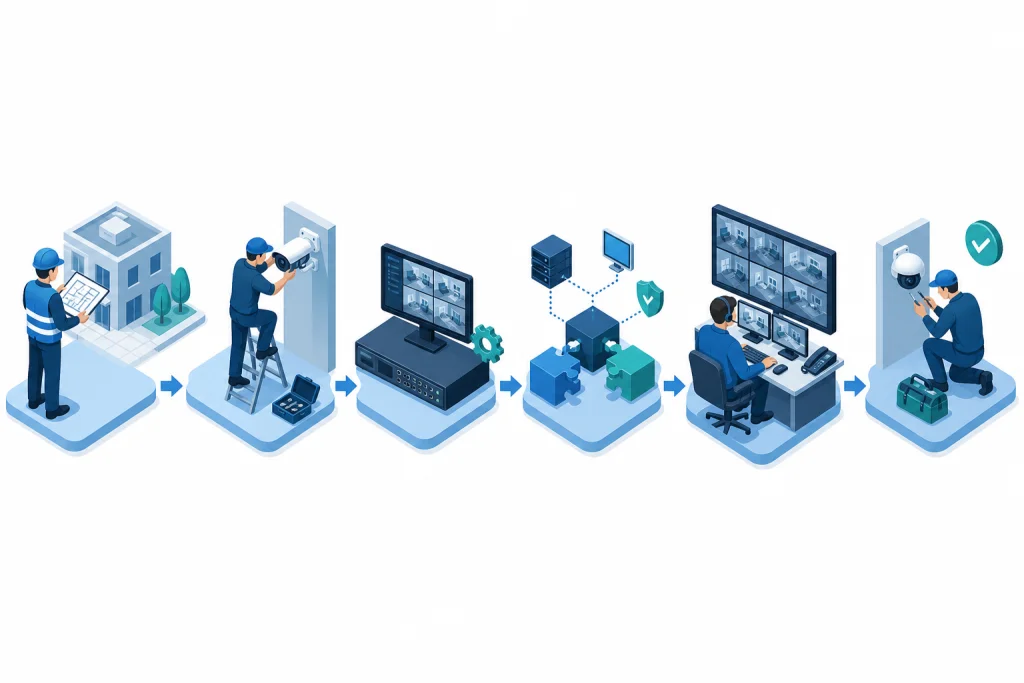
Case Study: A manufacturing company in Surabaya, Indonesia, faced a 12% shrinkage rate in raw materials due to theft and mismanagement. They deployed a SMART SURVEILLANCE system with 200 IP cameras (4K resolution) from HP, integrated with Synology NVRs using RAID 6 for redundancy. The system included AI analytics for object detection and license plate recognition at entry points. Implementation followed a phased methodology: Phase 1 (2 weeks) involved site survey and network assessment, ensuring adequate networking bandwidth. Phase 2 (4 weeks) installed cameras and configured edge analytics on Lenovo edge servers. Phase 3 (2 weeks) integrated the VMS with existing ERP for inventory tracking. Result: Shrinkage reduced to 2% within 6 months, a 10% improvement in production efficiency due to automated alerts for equipment downtime, and a 30% reduction in security personnel costs. The system paid for itself in 14 months.

Implementation methodology follows a structured approach: First, conduct a risk assessment to identify critical areas and define KPIs (e.g., detection accuracy >95%, latency <1 second). Second, design the architecture using a mix of edge and centralized processing, with server and storage sizing based on camera count and retention period. Third, deploy in a pilot zone (e.g., 20 cameras) to validate analytics and network performance. Fourth, roll out in phases, integrating with cybersecurity and disaster recovery plans. Finally, provide training and establish a maintenance schedule. This methodology ensures minimal disruption and maximum ROI, as demonstrated by the Surabaya case. For Indonesian enterprises, partnering with a system integrator like Intilogy ensures compliance with local regulations and optimal vendor selection from brands like QNAP and Dell.

SMART SURVEILLANCE Architecture

The architecture of a SMART SURVEILLANCE system is built on a multi-layered framework that combines edge devices, network infrastructure, and centralized management. At the edge, IP cameras with embedded AI processors (e.g., from HP or Lenovo) perform real-time object detection and classification. These cameras connect via Power over Ethernet (PoE) switches to a high-bandwidth networking backbone, ensuring low latency for video streaming. Data flows to network video recorders (NVRs) that handle storage and advanced analytics. For large-scale deployments, hyperconverged infrastructure (HCI) from vendors like VMware can virtualize NVR functions, improving resource utilization. Redundant storage arrays from Synology or QNAP ensure data integrity with RAID configurations and off-site backup via hybrid cloud integration. A centralized video management system (VMS) provides a unified dashboard for monitoring, playback, and alert configuration. The architecture also incorporates cybersecurity measures, such as encrypted video streams and role-based access control, to prevent unauthorized access. This modular design allows Indonesian enterprises to scale from a few cameras to thousands, adapting to evolving security needs.

Industry Use Cases for SMART SURVEILLANCE

SMART SURVEILLANCE is transforming operations across multiple industries in Indonesia. In manufacturing, AI-powered cameras monitor production lines for safety violations and equipment malfunctions, reducing downtime by 20-30%. For logistics and warehousing, video analytics track inventory movement, optimize forklift routes, and prevent theft. A logistics company in Jakarta implemented SMART SURVEILLANCE with Lenovo NVRs and saw a 15% increase in warehouse efficiency through automated slotting and congestion alerts. In retail, footfall counting and dwell time analysis help optimize store layouts and staffing, boosting sales conversion by up to 10%. For smart buildings and campuses, the system integrates with access control to provide seamless entry while flagging unauthorized attempts. Healthcare facilities use it to monitor patient rooms and restricted areas, ensuring compliance with privacy regulations. The technology also supports critical infrastructure, such as power plants and data centers, where thermal cameras detect overheating equipment. By combining video data with backup and disaster recovery strategies, enterprises ensure business continuity even during incidents. These use cases demonstrate that SMART SURVEILLANCE is not just about security—it's a tool for operational excellence.

How we work

Structured delivery from assessment to handover

Each phase has clear deliverables, owners, and acceptance criteria aligned to enterprise IT practice.

Approach

SMART SURVEILLANCE vs Traditional Alternatives

Traditional analog surveillance systems rely on coaxial cables, DVRs, and manual monitoring, limiting scalability and analytical capabilities. In contrast, SMART SURVEILLANCE uses IP-based cameras, NVRs, and AI analytics, offering superior image quality (4K and beyond), remote accessibility, and intelligent event detection. For example, a traditional system might require a security guard to watch 20 monitors simultaneously, leading to fatigue and missed incidents. SMART SURVEILLANCE automates this with motion detection, line crossing, and object recognition, alerting staff only when necessary. From a cost perspective, while the initial investment for SMART SURVEILLANCE is higher (20-30% more than analog), the total cost of ownership is lower due to reduced manpower needs and fewer false alarms. Analog systems also lack integration capabilities—they cannot easily connect with cybersecurity tools or IT infrastructure for unified management. Furthermore, storage efficiency is vastly improved: SMART SURVEILLANCE uses H.265 compression and edge recording to reduce storage requirements by up to 50% compared to analog. For Indonesian enterprises, the ability to scale from a few cameras to thousands without rewiring is a game-changer, especially in multi-site operations.

  • Another key differentiator is cybersecurity. Analog systems are often vulnerable to physical tampering and lack encryption, while SMART SURVEILLANCE employs end-to-end encryption, secure boot, and regular firmware updates. Vendors like Fortinet and Cisco provide network security appliances that protect video data in transit. Additionally, SMART SURVEILLANCE supports advanced features like license plate recognition and facial recognition, which are impossible with analog. Traditional systems also require extensive manual maintenance, such as cleaning VCR heads and replacing tapes, whereas SMART SURVEILLANCE uses solid-state drives and cloud backups from hybrid cloud providers, reducing maintenance overhead. In summary, for enterprises seeking a future-proof, scalable, and intelligent security solution, SMART SURVEILLANCE outperforms traditional alternatives in every metric.

Capabilities

Case Study & Implementation Methodology

Case Study: A manufacturing company in Surabaya, Indonesia, faced a 12% shrinkage rate in raw materials due to theft and mismanagement. They deployed a SMART SURVEILLANCE system with 200 IP cameras (4K resolution) from HP, integrated with Synology NVRs using RAID 6 for redundancy. The system included AI analytics for object detection and license plate recognition at entry points. Implementation followed a phased methodology: Phase 1 (2 weeks) involved site survey and network assessment, ensuring adequate networking bandwidth. Phase 2 (4 weeks) installed cameras and configured edge analytics on Lenovo edge servers. Phase 3 (2 weeks) integrated the VMS with existing ERP for inventory tracking. Result: Shrinkage reduced to 2% within 6 months, a 10% improvement in production efficiency due to automated alerts for equipment downtime, and a 30% reduction in security personnel costs. The system paid for itself in 14 months.

  • Implementation methodology follows a structured approach: First, conduct a risk assessment to identify critical areas and define KPIs (e.g., detection accuracy >95%, latency <1 second). Second, design the architecture using a mix of edge and centralized processing, with server and storage sizing based on camera count and retention period. Third, deploy in a pilot zone (e.g., 20 cameras) to validate analytics and network performance. Fourth, roll out in phases, integrating with cybersecurity and disaster recovery plans. Finally, provide training and establish a maintenance schedule. This methodology ensures minimal disruption and maximum ROI, as demonstrated by the Surabaya case. For Indonesian enterprises, partnering with a system integrator like Intilogy ensures compliance with local regulations and optimal vendor selection from brands like QNAP and Dell.
Use cases

Perencanaan infrastruktur baru

Refresh & modernisasi

Ekspansi multi-cabang

Compliance & audit IT

SMART SURVEILLANCE for Enterprise

Our engineers help design, deploy, and support enterprise IT solutions across Indonesia.

Request a quote Contact our team

Related pages

E-E-A-T · Expertise & trust

Implementation expertise & enterprise trust

Intilogy (PT. Inti Jaya Teknologi) supports IT and procurement teams across Indonesia — from technical assessment and BoQ through deployment, documentation, and post go-live support.

  • 500+ Infrastructure deployments
  • 24/7 Operational support
  • SLA Enterprise SLA
  • 150+ Clients & institutions

Engineering & delivery expertise

Engineer-led assessment

Requirements workshops, sizing, and architecture — not catalogue selling without context.

Documented deployment

Commissioning checklists, as-built diagrams, IP plans, and escalation runbooks.

Audit-ready procurement

BoQ/BOM, quotations, POs, and handover packs for tenders and IT audits.

Multi-vendor coordination

One project partner for servers, networks, security, backup, and licensing.

Vendor ecosystem & sourcing channels

We source through official distributors/resellers per brand and project. Specific partnership tiers are confirmed per RFP — see our credentials page.

Vendor Status / tier Scope Notes
Dell Technologies Authorized channel PowerEdge, storage BoQ & manufacturer warranty
HPE Authorized channel ProLiant Enterprise servers
Fortinet Implementation partner NGFW, SD-WAN Licensing & deployment
Veeam Implementation partner Backup, replication Immutable design
VMware Implementation partner vSphere Cluster & migration

Tiers vary by SKU/region. Contact sales@intilogy.com for distributor letters or engineer certificates.

Enterprise implementation methodology

Standard flow for infrastructure, security, and backup projects — scoped per contract.

  1. Discovery & assessment

    Duration: 1–2 weeks

    Deliverables Requirements & risk report

  2. Architecture & BoQ

    Duration: 1–2 weeks

    Deliverables HLD, BoQ, rollout plan

  3. Procurement & staging

    Duration: 2–4 weeks

    Deliverables Asset register

  4. Implementation & UAT

    Duration: 2–6 weeks

    Deliverables As-built, UAT sign-off

  5. Handover & operations

    Duration: Ongoing

    Deliverables SOPs, training, SLA if contracted

Support & SLA (per project contract)

Service levels are defined in agreement — example framework below.

Standard maintenance

Response
Next business day (remote)
Coverage
Firmware advisory, tickets, RMA
Notes
Indonesia business hours

Project warranty

Response
Per implementation contract
Coverage
Defects in Intilogy deployment scope
Notes
Not 24/7 unless agreed

Critical incident (optional)

Response
4–8 hours if contracted
Coverage
Production-critical escalation
Notes
Requires separate MSA

Response times are illustrative — binding only when written in contract.

Technical documentation delivered

  • Topology & rack diagrams (as-built)
  • Asset list, serials, warranty status
  • Critical config summary & change log
  • Basic operations runbook & escalation contacts
  • Restore / DR drill reports (if in scope)
  • Tender packs: distributor letters & engineer certs (on request)

Competency & certifications

Engineers train on vendor technologies per project. Individual certs (Fortinet NSE, VMware VCP, Veeam VMCE, etc.) are provided for tenders — not all listed publicly.

  • Engineer certifications — Per project technology — on request
  • Distributor letters — For procurement audit
  • Client references — See Clients page for logos & scope

View certifications & partnerships

Ready to discuss architecture & BoQ?

Our team supports assessment, recommendations, procurement, and documented implementation.

WhatsApp Consult on WhatsApp
Request Consultation WhatsApp