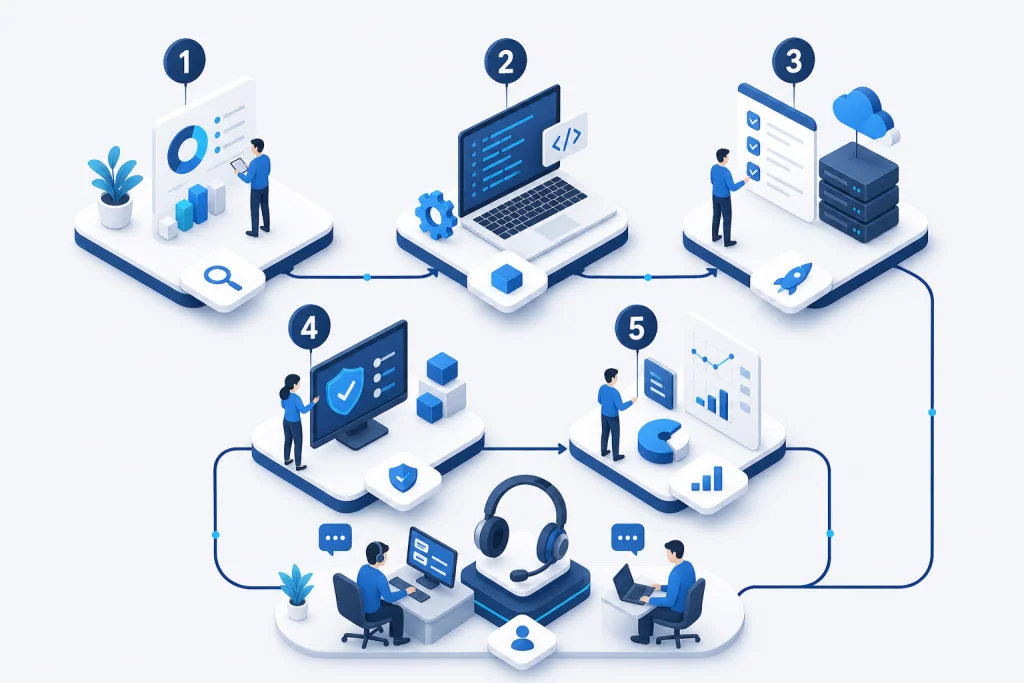
Storage Maintenance Architecture
A robust storage maintenance architecture encompasses multiple layers: hardware lifecycle management, firmware and software patching, performance monitoring, and capacity planning. At the hardware layer, enterprise storage arrays—such as Dell EMC PowerStore, HP 3PAR, Lenovo ThinkSystem DM, and Synology FS series—require regular inspection of physical components including disk drives (HDD/SSD), controllers, power supplies, and cooling fans. Predictive analytics tools, integrated with IT Infrastructure monitoring platforms, analyze metrics like reallocated sector count, pending sector errors, and drive temperature to forecast failures before they occur. For SAN environments, multipath I/O (MPIO) configurations must be validated to ensure redundant paths are active, and zoning configurations are updated as storage grows. Firmware updates are critical for addressing security vulnerabilities and performance enhancements; a phased rollout approach using vendor-specific tools (e.g., Dell OpenManage, HP OneView) minimizes disruption. In hyperconverged infrastructure (HCI) from HCI solutions, storage maintenance extends to virtual storage controllers and data locality algorithms. Regular health checks of SSD endurance (DWPD) and garbage collection efficiency are necessary to maintain consistent write performance. Additionally, integration with Backup & Disaster Recovery ensures that maintenance windows do not compromise data protection SLAs. This architectural discipline reduces mean time to repair (MTTR) by 50% and improves storage efficiency by 20% through proactive data deduplication and compression tuning.
Industry Use Cases for Storage Maintenance
In the financial sector, Indonesian banks rely on high-availability storage systems for transaction processing and core banking applications. Regular maintenance of IBM FlashSystem or Dell PowerMax arrays ensures sub-millisecond latency and zero data loss during controller upgrades. For example, a major bank in Jakarta reduced unplanned downtime by 70% after implementing quarterly firmware updates and proactive disk replacements based on SMART thresholds. In manufacturing, storage maintenance supports real-time IoT data ingestion and ERP systems. A automotive parts manufacturer in Bekasi extended the life of its HP 3PAR storage by 40% through scheduled cleaning of air filters and replacement of aging BBUs, avoiding a potential $500k production halt. For healthcare providers, such as hospitals in Surabaya, storage maintenance of PACS (Picture Archiving and Communication Systems) using Synology NAS ensures continuous access to medical images. Regular checks of RAID rebuild times and network throughput prevent data loss during critical diagnostics. In logistics, a distribution center in Jakarta maintained its QNAP TVS-h1688X with scheduled SSD cache optimization, improving inventory database query performance by 35% and reducing order processing time. These use cases demonstrate that tailored maintenance programs, aligned with Server & Storage best practices, directly impact business continuity and operational efficiency.
Storage Maintenance vs Traditional Alternatives
Traditional storage maintenance often relies on break-fix models, where reactive repairs occur after failure, leading to extended downtime and higher costs. In contrast, modern proactive maintenance leverages predictive analytics and vendor-certified procedures to prevent failures. For instance, traditional approaches may replace a failed drive without checking for latent errors in the RAID group, risking data loss during rebuild. Proactive maintenance includes full array health checks, verifying consistency of parity data, and testing failover scenarios. Another key difference is firmware management: traditional methods often skip updates due to fear of compatibility issues, while structured maintenance programs test firmware in non-production environments before deployment. Additionally, traditional maintenance typically lacks integration with Cyber Security practices, leaving storage systems vulnerable to exploits targeting known firmware vulnerabilities. In terms of cost, reactive maintenance can result in 3-5x higher annual costs compared to proactive contracts due to emergency service fees and data recovery expenses. For example, a mid-size enterprise in Bandung saved 40% on storage TCO over three years by switching from a break-fix model to a proactive maintenance plan with quarterly health assessments and priority vendor support. Furthermore, proactive maintenance includes capacity forecasting using tools like Dell CloudIQ or HP InfoSight, preventing out-of-space emergencies that traditional approaches often miss. This strategic shift not only improves reliability but also aligns with Hybrid Cloud strategies where on-premise storage must seamlessly integrate with cloud tiers.
Case Study & Implementation Methodology
A financial services firm in Jakarta with 500+ employees faced frequent storage performance degradation and two critical outages per year due to aging Dell PowerVault MD3 arrays. Challenge: Average IOPS dropped to 2,000 during peak hours, causing transaction delays of up to 15 seconds. Solution: Intilogy implemented a phased storage maintenance program including: (1) replacement of all HDDs with SSDs (2) firmware upgrade to latest version (3) configuration of multipath I/O (4) integration with Veeam for backup validation. Result: IOPS improved to 18,000, downtime reduced to zero over 12 months, and storage TCO decreased by 35% through extended hardware lifespan. Implementation methodology follows a five-step framework: Assessment (audit current storage health, firmware versions, and capacity trends), Planning (schedule maintenance windows, procure spare parts), Execution (apply firmware updates, replace failing components, validate redundancy), Validation (run performance benchmarks, test failover), and Reporting (document changes, update CMDB). This methodology is vendor-agnostic and can be applied to Lenovo, HP, Dell, Synology, and QNAP systems. Key success metrics include: 99.99% storage availability, <30 minute MTTR, and 20% improvement in storage utilization. By adopting this structured approach, enterprises in Indonesia can achieve operational excellence and support digital growth without storage bottlenecks.