Enterprise IT Solutions

Inventory Tracking for Enterprise

Enterprise inventory tracking in Indonesia demands real-time visibility across complex supply chains, from raw material warehouses to finished goods distribution centers. Traditional manual methods or basic barcode systems fail to address the scale and granularity required by large B2B operations. Modern inventory tracking leverages a multi-layered architecture combining passive and active RFID tags, industrial-grade barcode scanners, IoT-enabled weight sensors, and cloud-based inventory management platforms. These systems integrate with ERP (e.g., SAP S/4HANA, Oracle NetSuite) and WMS (e.g., Manhattan, Blue Yonder) through RESTful APIs and EDI protocols, enabling automated data capture at every touchpoint—receiving, putaway, picking, packing, and shipping. For Indonesian enterprises, where infrastructure varies from modern distribution centers to remote field locations, a hybrid approach using both fixed RFID portals and handheld mobile computers (e.g., Zebra TC8300, Honeywell CK65) ensures coverage. Edge computing nodes process raw RFID reads locally, filtering duplicates and applying business rules before syncing to the cloud via 4G/5G or LoRaWAN. This reduces latency and bandwidth costs. Advanced analytics, powered by machine learning models, predict demand fluctuations and optimize reorder points, reducing carrying costs by up to 25%. Security is paramount: encrypted data transmission, role-based access, and blockchain-based audit trails prevent tampering. Intilogy's enterprise inventory tracking solutions are deployed across manufacturing, retail, logistics, and healthcare sectors in Indonesia, achieving 99.9% inventory accuracy and 30% faster cycle counts. By integrating with existing IT infrastructure, such as Lenovo servers and Synology NAS for local storage, enterprises maintain operational continuity even during internet outages. The result is a resilient, scalable system that supports business growth while minimizing shrinkage and stockouts.

Inventory Tracking Architecture

The architecture of an enterprise inventory tracking system is a multi-tiered stack designed for high throughput and low latency. At the edge, hardware components include RFID readers (e.g., Impinj xArray, Zebra FX9600), barcode scanners (e.g., Datalogic Magellan 9800i), and IoT sensors (e.g., Bosch XDK110 for temperature/humidity). These devices communicate via Wi-Fi 6, Bluetooth 5.0, or wired Ethernet to edge servers running middleware like Zebra Savanna or OAT Foundation Suite. The middleware handles data normalization, duplicate filtering, and real-time event generation. Processed data flows to the integration layer, which connects to ERP and WMS via APIs or message queues (e.g., RabbitMQ, Apache Kafka). For Indonesian enterprises with multiple locations, a centralized cloud platform (AWS, Azure, or on-premise with VMware) aggregates data, providing a single dashboard. Redundancy is achieved through local caching on QNAP NAS devices, ensuring operations continue if WAN fails. Security is enforced via TLS 1.3, OAuth 2.0, and hardware security modules (HSM) for key management. The system supports 500+ reads per second per reader, with sub-second latency from scan to dashboard update.

Scalability is built-in: additional readers can be provisioned via zero-touch deployment using DHCP and TFTP. For high-density environments like pallet-level tracking, phased-array RFID antennas (e.g., Times-7 A5010) provide 3D location accuracy within 30 cm. Power over Ethernet (PoE+) simplifies installation. The architecture also supports mobile workers using ruggedized tablets (e.g., Dell Latitude 7220 Rugged) with integrated UHF RFID sleds. Data retention policies ensure compliance with Indonesian regulations, storing transactional data for 5 years on Synology Active Backup for Business.

Industry Use Cases for Inventory Tracking

In manufacturing, inventory tracking enables just-in-time (JIT) production by monitoring raw material levels in real time. For example, an automotive parts supplier in Bekasi uses RFID-tagged bins on assembly lines, triggering automatic replenishment orders when stock falls below 10% of min-max levels. This reduced line stoppages by 40%. In retail, omnichannel fulfillment relies on accurate inventory across stores and warehouses. A fashion retailer in Jakarta implemented RFID at the item level, achieving 98% inventory accuracy and enabling click-and-collect with 15-minute pickup times. In logistics, third-party warehouses (3PL) use barcode scanning and weight verification at dock doors to reconcile inbound shipments. A logistics hub in Surabaya integrated Cisco networking with Zebra scanners, cutting receiving time by 50%. Healthcare requires tracking of medical devices and pharmaceuticals. A hospital in Bandung uses UHF RFID for surgical instrument trays, ensuring sterilization compliance and reducing loss by 60%. Cold chain monitoring is critical: IoT sensors from Dell Edge Gateways track temperature in vaccine storage, sending alerts if thresholds are exceeded.

Other sectors include oil & gas, where RFID tags on pipes and valves in Balikpapan enable automated inventory audits, reducing manual checks by 70%. In agriculture, a palm oil plantation in Riau tracks spare parts for heavy machinery using ruggedized barcode labels, decreasing downtime by 25%. Each use case demands customization: integration with existing hybrid cloud environments, support for Indonesian language interfaces, and compliance with local data privacy laws (UU ITE). Intilogy's solutions are vendor-agnostic, allowing best-of-breed components from HP, Lenovo, and Fortinet for security.

Inventory Tracking vs Traditional Alternatives

Traditional inventory management relies on periodic physical counts, spreadsheets, or basic barcode scanning. These methods suffer from latency (up to weeks between counts), human error (5-10% inaccuracy), and lack of granularity (only location-level, not item-level). In contrast, modern inventory tracking provides real-time visibility with 99.9% accuracy using RFID and IoT. For example, a manual cycle count of 10,000 SKUs takes 40 hours; an RFID-based system completes it in 2 hours with 100% accuracy. Traditional systems also fail to prevent theft or misplacement: shrinkage rates average 2% of revenue, while RFID reduces it to 0.5%. Cost-wise, traditional barcode systems have lower upfront hardware costs ($0.02 per barcode label vs $0.10 per RFID tag) but higher labor costs. For an enterprise with 500,000 items, RFID yields ROI in 18 months via labor savings and reduced stockouts. Another alternative, manual pen-and-paper, is still used in some Indonesian SMEs, but it is unscalable and error-prone.

Cloud-based inventory platforms (e.g., Oracle WMS Cloud, SAP EWM) offer advanced features like predictive analytics and multi-tenant support, but require robust IT infrastructure. On-premise solutions using HP ProLiant servers and VMware virtualization provide lower latency for real-time operations. Hybrid approaches combine the best: edge devices process data locally, while the cloud handles analytics and reporting. Security is another differentiator: traditional systems lack encryption and audit trails, whereas modern systems use blockchain for immutable logs. For Indonesian enterprises, regulatory compliance (e.g., BPOM for pharmaceuticals) mandates traceability, which only digital tracking can provide. Ultimately, inventory tracking is not just a replacement but a transformation, enabling lean operations and data-driven decision-making.

Case Study & Implementation Methodology

Manufacturing Company in Karawang, Challenge: 15% inventory inaccuracy, 20% stockout rate, manual cycle counts took 3 days for 50,000 SKUs. Solution: Deployed 20 Zebra FX9600 RFID readers, 500,000 passive UHF tags, integrated with SAP S/4HANA via middleware. Used Cisco Catalyst switches for network backbone and Fortinet FortiGate for security. Result: Inventory accuracy improved to 99.7%, stockouts reduced to 2%, cycle counts now take 4 hours, annual labor savings of $120,000.

Logistics Company in Surabaya, Challenge: 8% shipment errors, 12% overtime costs due to manual check-in. Solution: Implemented barcode scanning with Datalogic Magellan 9800i at 10 dock doors, integrated with WMS (Manhattan Associates) on Lenovo ThinkSystem servers. Used Synology RackStation for local backup. Result: Shipment accuracy reached 99.9%, overtime reduced by 50%, ROI achieved in 14 months.

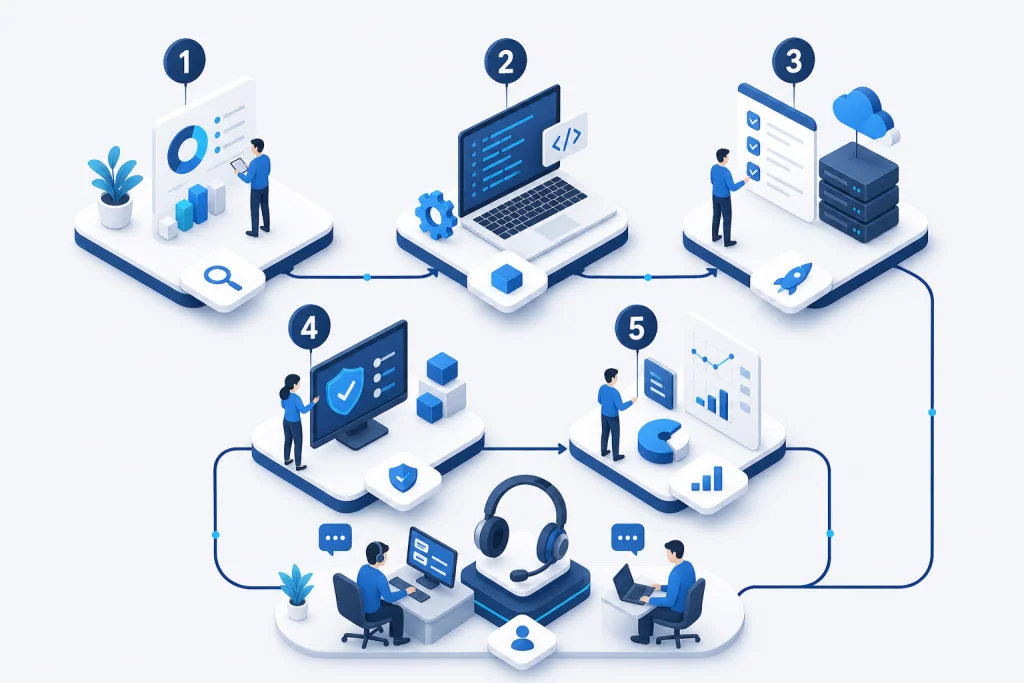
Implementation Methodology follows Intilogy's 5-phase approach: (1) Assessment - analyze current processes, SKU volume, facility layout; (2) Design - select hardware, define tag placement, network topology; (3) Pilot - deploy in one zone, tune read rates; (4) Rollout - phased expansion across locations; (5) Optimization - continuous monitoring using backup and disaster recovery plans. Each phase includes training for operators and IT staff, with 24/7 support from Intilogy's team. Post-implementation, monthly reviews track KPIs: accuracy, throughput, and ROI. This methodology ensures minimal disruption and maximum adoption.

Inventory Tracking Architecture

The architecture of an enterprise inventory tracking system is a multi-tiered stack designed for high throughput and low latency. At the edge, hardware components include RFID readers (e.g., Impinj xArray, Zebra FX9600), barcode scanners (e.g., Datalogic Magellan 9800i), and IoT sensors (e.g., Bosch XDK110 for temperature/humidity). These devices communicate via Wi-Fi 6, Bluetooth 5.0, or wired Ethernet to edge servers running middleware like Zebra Savanna or OAT Foundation Suite. The middleware handles data normalization, duplicate filtering, and real-time event generation. Processed data flows to the integration layer, which connects to ERP and WMS via APIs or message queues (e.g., RabbitMQ, Apache Kafka). For Indonesian enterprises with multiple locations, a centralized cloud platform (AWS, Azure, or on-premise with VMware) aggregates data, providing a single dashboard. Redundancy is achieved through local caching on QNAP NAS devices, ensuring operations continue if WAN fails. Security is enforced via TLS 1.3, OAuth 2.0, and hardware security modules (HSM) for key management. The system supports 500+ reads per second per reader, with sub-second latency from scan to dashboard update.

Industry Use Cases for Inventory Tracking

In manufacturing, inventory tracking enables just-in-time (JIT) production by monitoring raw material levels in real time. For example, an automotive parts supplier in Bekasi uses RFID-tagged bins on assembly lines, triggering automatic replenishment orders when stock falls below 10% of min-max levels. This reduced line stoppages by 40%. In retail, omnichannel fulfillment relies on accurate inventory across stores and warehouses. A fashion retailer in Jakarta implemented RFID at the item level, achieving 98% inventory accuracy and enabling click-and-collect with 15-minute pickup times. In logistics, third-party warehouses (3PL) use barcode scanning and weight verification at dock doors to reconcile inbound shipments. A logistics hub in Surabaya integrated Cisco networking with Zebra scanners, cutting receiving time by 50%. Healthcare requires tracking of medical devices and pharmaceuticals. A hospital in Bandung uses UHF RFID for surgical instrument trays, ensuring sterilization compliance and reducing loss by 60%. Cold chain monitoring is critical: IoT sensors from Dell Edge Gateways track temperature in vaccine storage, sending alerts if thresholds are exceeded.

How we work

Structured delivery from assessment to handover

Each phase has clear deliverables, owners, and acceptance criteria aligned to enterprise IT practice.

Approach

Inventory Tracking vs Traditional Alternatives

Traditional inventory management relies on periodic physical counts, spreadsheets, or basic barcode scanning. These methods suffer from latency (up to weeks between counts), human error (5-10% inaccuracy), and lack of granularity (only location-level, not item-level). In contrast, modern inventory tracking provides real-time visibility with 99.9% accuracy using RFID and IoT. For example, a manual cycle count of 10,000 SKUs takes 40 hours; an RFID-based system completes it in 2 hours with 100% accuracy. Traditional systems also fail to prevent theft or misplacement: shrinkage rates average 2% of revenue, while RFID reduces it to 0.5%. Cost-wise, traditional barcode systems have lower upfront hardware costs ($0.02 per barcode label vs $0.10 per RFID tag) but higher labor costs. For an enterprise with 500,000 items, RFID yields ROI in 18 months via labor savings and reduced stockouts. Another alternative, manual pen-and-paper, is still used in some Indonesian SMEs, but it is unscalable and error-prone.

  • Cloud-based inventory platforms (e.g., Oracle WMS Cloud, SAP EWM) offer advanced features like predictive analytics and multi-tenant support, but require robust IT infrastructure. On-premise solutions using HP ProLiant servers and VMware virtualization provide lower latency for real-time operations. Hybrid approaches combine the best: edge devices process data locally, while the cloud handles analytics and reporting. Security is another differentiator: traditional systems lack encryption and audit trails, whereas modern systems use blockchain for immutable logs. For Indonesian enterprises, regulatory compliance (e.g., BPOM for pharmaceuticals) mandates traceability, which only digital tracking can provide. Ultimately, inventory tracking is not just a replacement but a transformation, enabling lean operations and data-driven decision-making.

Capabilities

Case Study & Implementation Methodology

Manufacturing Company in Karawang, Challenge: 15% inventory inaccuracy, 20% stockout rate, manual cycle counts took 3 days for 50,000 SKUs. Solution: Deployed 20 Zebra FX9600 RFID readers, 500,000 passive UHF tags, integrated with SAP S/4HANA via middleware. Used Cisco Catalyst switches for network backbone and Fortinet FortiGate for security. Result: Inventory accuracy improved to 99.7%, stockouts reduced to 2%, cycle counts now take 4 hours, annual labor savings of $120,000.

  • Logistics Company in Surabaya, Challenge: 8% shipment errors, 12% overtime costs due to manual check-in. Solution: Implemented barcode scanning with Datalogic Magellan 9800i at 10 dock doors, integrated with WMS (Manhattan Associates) on Lenovo ThinkSystem servers. Used Synology RackStation for local backup. Result: Shipment accuracy reached 99.9%, overtime reduced by 50%, ROI achieved in 14 months.
  • Implementation Methodology follows Intilogy's 5-phase approach: (1) Assessment - analyze current processes, SKU volume, facility layout; (2) Design - select hardware, define tag placement, network topology; (3) Pilot - deploy in one zone, tune read rates; (4) Rollout - phased expansion across locations; (5) Optimization - continuous monitoring using backup and disaster recovery plans. Each phase includes training for operators and IT staff, with 24/7 support from Intilogy's team. Post-implementation, monthly reviews track KPIs: accuracy, throughput, and ROI. This methodology ensures minimal disruption and maximum adoption.

Use cases

Perencanaan infrastruktur baru

Refresh & modernisasi

Ekspansi multi-cabang

Compliance & audit IT

Inventory Tracking for Enterprise

Our engineers help design, deploy, and support enterprise IT solutions across Indonesia.

Request a quote Contact our team

Case studies

Studi Kasus Terkait

Proyek nyata di lapangan — tantangan spesifik, solusi terukur, dan hasil yang terdokumentasi.

WMS Multi Channel Reseller Stock for Enterprise

Industry Retail / Distribution

Challenge The legacy system caused 12-hour backup failures during peak season, leading to 3-day inventory reconciliation delays. Stock accuracy was only 85%, resulting in 15% of orders being shipped incorrectly. Multi-channel orde

Result Stock accuracy improved to 99.5%, reducing order errors by 90%. Stockouts decreased from 20% to 5%, and overstock reduced by 40%. Order processing time dropped from 4 hours to 30 minutes. The company achieved a 30% incre

Barcode Inventory System for Enterprise

Industry Enterprise

Challenge The primary challenge was the high error rate in inventory records. Manual data entry resulted in approximately 12% inaccuracy, causing stockouts of critical components and excess inventory of slow-moving items. This led

Result Post-implementation, inventory accuracy improved to 99.5%, reducing stockouts by 90%. Cycle counting now takes 4 hours per warehouse without disrupting operations. The company eliminated 15 data entry positions through a

Barcode WMS Integration for Enterprise

Industry Logistics

Challenge The primary challenge was a 23% inventory inaccuracy rate, causing annual losses of over IDR 5 billion due to overstocking and stockouts. Manual data entry resulted in average 2-hour delays in updating SAP after goods re

Result Post-implementation, inventory accuracy improved from 77% to 99.5%. Order fulfillment errors dropped to under 1%, and the 2-hour data entry delay was eliminated, achieving real-time SAP updates. The RPO (Recovery Point O

CCTV Warehouse Perimeter for Enterprise

Industry Logistics

Challenge The primary challenge was covering a 2km perimeter with high-resolution cameras while maintaining reliable recording and analytics. The existing network infrastructure had limited bandwidth, with only 1Gbps backbone and

Result Post-implementation, the warehouse perimeter achieved 99.9% uptime with zero recording gaps during power outages, thanks to a new UPS system and failover to <a href="/solisi/hybrid-cloud">hybrid cloud</a> storage. The AI

RFID Retail Inventory for Enterprise

Industry Retail

Challenge The primary technical challenge was the lack of real-time inventory visibility across the entire supply chain. Manual barcode scanning required employees to physically scan each item, which was impossible for high-volume

Result Post-implementation, inventory accuracy improved from 85% to 99.5%, reducing stockouts by 90%. The company reported a 70% reduction in manual labor for inventory counts, saving IDR 15 billion annually in labor costs. Shr

RFID Warehouse for Enterprise

Industry Logistics & Warehousing

Challenge The manual barcode scanning process caused a 12% error rate in inventory counts, leading to stock discrepancies worth over $500,000 annually. Cycle counting required 20 staff working 8-hour shifts, yet accuracy remained

Result Post-implementation, inventory accuracy improved from 85% to 99.8%, reducing stock discrepancies by $450,000 annually. Cycle counting time dropped from 8 hours to 30 minutes per shift, freeing up 15 staff for other tasks

Related pages

E-E-A-T · Expertise & trust

Implementation expertise & enterprise trust

Intilogy (PT. Inti Jaya Teknologi) supports IT and procurement teams across Indonesia — from technical assessment and BoQ through deployment, documentation, and post go-live support.

  • 500+ Infrastructure deployments
  • 24/7 Operational support
  • SLA Enterprise SLA
  • 150+ Clients & institutions

Engineering & delivery expertise

Engineer-led assessment

Requirements workshops, sizing, and architecture — not catalogue selling without context.

Documented deployment

Commissioning checklists, as-built diagrams, IP plans, and escalation runbooks.

Audit-ready procurement

BoQ/BOM, quotations, POs, and handover packs for tenders and IT audits.

Multi-vendor coordination

One project partner for servers, networks, security, backup, and licensing.

Vendor ecosystem & sourcing channels

We source through official distributors/resellers per brand and project. Specific partnership tiers are confirmed per RFP — see our credentials page.

Vendor Status / tier Scope Notes
Dell Technologies Authorized channel PowerEdge, storage BoQ & manufacturer warranty
HPE Authorized channel ProLiant Enterprise servers
Fortinet Implementation partner NGFW, SD-WAN Licensing & deployment
Veeam Implementation partner Backup, replication Immutable design
VMware Implementation partner vSphere Cluster & migration

Tiers vary by SKU/region. Contact sales@intilogy.com for distributor letters or engineer certificates.

Enterprise implementation methodology

Standard flow for infrastructure, security, and backup projects — scoped per contract.

  1. Discovery & assessment

    Duration: 1–2 weeks

    Deliverables Requirements & risk report

  2. Architecture & BoQ

    Duration: 1–2 weeks

    Deliverables HLD, BoQ, rollout plan

  3. Procurement & staging

    Duration: 2–4 weeks

    Deliverables Asset register

  4. Implementation & UAT

    Duration: 2–6 weeks

    Deliverables As-built, UAT sign-off

  5. Handover & operations

    Duration: Ongoing

    Deliverables SOPs, training, SLA if contracted

Support & SLA (per project contract)

Service levels are defined in agreement — example framework below.

Standard maintenance

Response
Next business day (remote)
Coverage
Firmware advisory, tickets, RMA
Notes
Indonesia business hours

Project warranty

Response
Per implementation contract
Coverage
Defects in Intilogy deployment scope
Notes
Not 24/7 unless agreed

Critical incident (optional)

Response
4–8 hours if contracted
Coverage
Production-critical escalation
Notes
Requires separate MSA

Response times are illustrative — binding only when written in contract.

Technical documentation delivered

  • Topology & rack diagrams (as-built)
  • Asset list, serials, warranty status
  • Critical config summary & change log
  • Basic operations runbook & escalation contacts
  • Restore / DR drill reports (if in scope)
  • Tender packs: distributor letters & engineer certs (on request)

Competency & certifications

Engineers train on vendor technologies per project. Individual certs (Fortinet NSE, VMware VCP, Veeam VMCE, etc.) are provided for tenders — not all listed publicly.

  • Engineer certifications — Per project technology — on request
  • Distributor letters — For procurement audit
  • Client references — See Clients page for logos & scope

View certifications & partnerships

Ready to discuss architecture & BoQ?

Our team supports assessment, recommendations, procurement, and documented implementation.

WhatsApp Consult on WhatsApp
Request Consultation WhatsApp